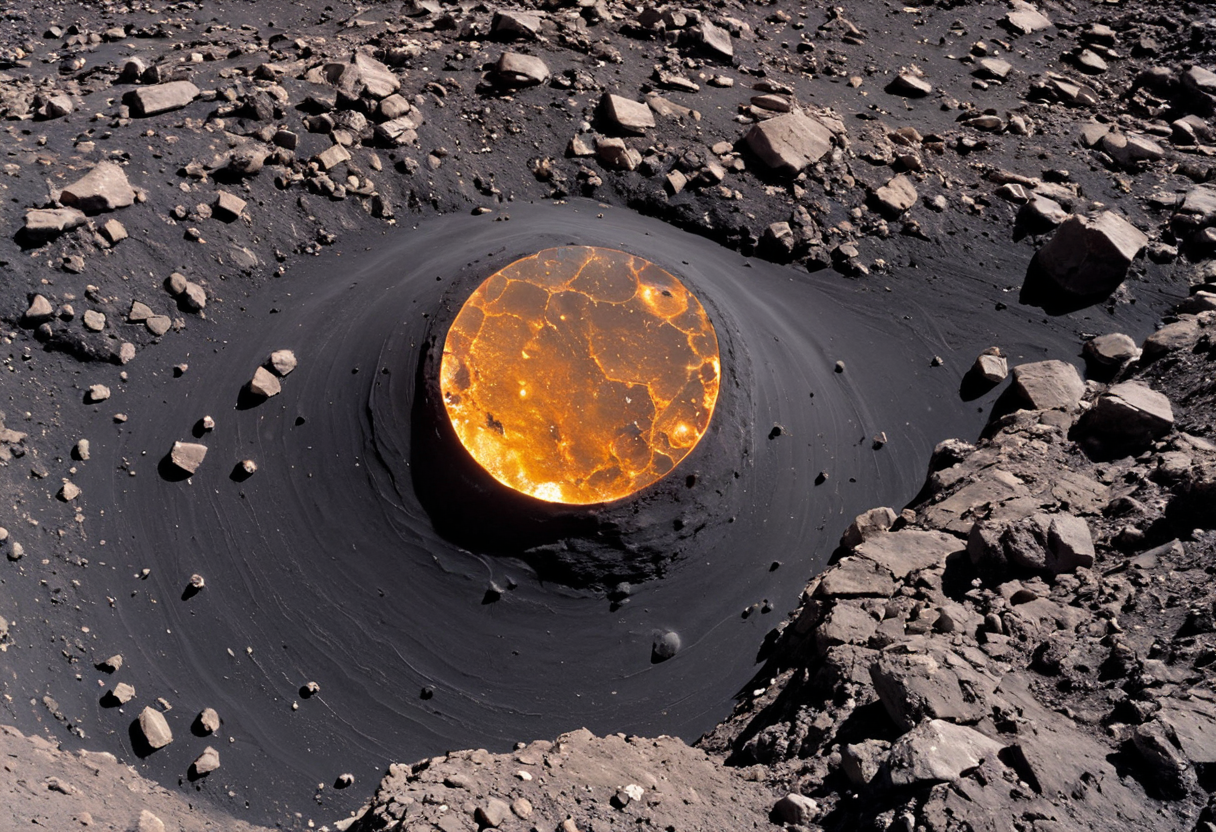
The two scientists agreed on most of Karrek's chemistry and parted ways only on its interpretation. Both saw a planet whose 73 percent CO2 atmosphere is held in a metastable steady state by supply-limited carbonation under a stagnant lid, whose deep crust is slowly serpentinizing iron-rich olivine and producing abiotic methane and Fischer-Tropsch alkanes, and whose 38-degree obliquity drives a real annual frost cycle at the winter pole. Lithos, the substrate-first geochemist, argued that the iron-sulfate regolith built up over 6 Gyr poisons every productive solvent it touches: cap brines buffer to acidic sulfate-bisulfate at pH 3-4 where HCN hydrolyzes faster than it polymerizes, equatorial regolith oxidizes haze fallout, and the deep brine's low dielectric and mineral-buffered pH make it a Lost City vent rather than a replicator engine. Solvent, the medium-first photochemist, accepted lithos's mineral framing wholesale but reread the same numbers as productive — HCN going to formamide is not destruction but synthesis of the most powerful single-component prebiotic solvent known, freeze-concentration in eutectic films runs polymerization on timescales comparable to hydrolysis, and the low-dielectric deep brine favors peptide bond formation and metal-organic complexation. They split the difference on numbers (atmospheric methane sub-ppb, HCN production order 1e5-1e6 molecules/cm2/s, integrated tholin sediment millimeter-scale at the cap) and held an honest disagreement on Strecker yields in sulfate eutectics, which the literature does not yet resolve. The world they describe is chemically alive at modest amplitude — every prebiotic ingredient present, every reaction venue open, but each venue too small or too brief or too sealed-off to host the assembly of replicators.
Locked state
{
  "stage": "chemistry",
  "schema_version": 1,
  "active_chemistry_score": 5,
  "dominant_environments": [
    {
      "name": "polar seasonal frost cap and spring-terminator brine films",
      "phase": "ice",
      "temperature_k": 235,
      "pressure_bar": 2.5,
      "key_reactions": [
        "H2O(g) + H2SO4 aerosol -> co-condensed sulfate-bisulfate frost",
        "MgSO4 + H2SO4*nH2O -> buffered brine, pH 3-4 at 220-270 K",
        "HCN + H2O -> HCONH2 (formamide) at k ~ 1e-7 /s, 250 K",
        "HCN polymerization in freeze-concentrated brine pockets, k_polym ~ 1e-5 to 1e-3 /s",
        "tholin-aerosol fallout dissolving into formamide-water eutectic",
        "Fe(III)/SO4(2-) oxidation of organics at melt edges"
      ],
      "redox_state": "oxidizing",
      "active": true
    },
    {
      "name": "deep crustal serpentinizing brine reservoir",
      "phase": "liquid",
      "temperature_k": 500,
      "pressure_bar": 1500,
      "key_reactions": [
        "6 (Mg,Fe)2SiO4 + 7 H2O -> 3 Mg3Si2O5(OH)4 + Fe3O4 + H2",
        "CO2 + 4 H2 -> CH4 + 2 H2O on awaruite/magnetite (Sabatier)",
        "Fischer-Tropsch-type C2-C5 alkane synthesis on grain-boundary catalysts",
        "radiolytic H2O -> H2 + OH from 40K decay (~1e-3 Gy/yr)",
        "formate-acetate-pyruvate ladder in alkaline serpentinizing fluid",
        "Mg2+/Fe2+ - organic complexation in low-dielectric (epsilon ~30) fluid"
      ],
      "redox_state": "reducing",
      "active": true
    },
    {
      "name": "XUV-driven mesosphere and homopause",
      "phase": "gas",
      "temperature_k": 220,
      "pressure_bar": 0.000001,
      "key_reactions": [
        "CO2 + hv (lambda<200 nm) -> CO + O(1D)",
        "H2O + hv -> OH + H",
        "N2 + hv (lambda<100 nm) -> N(4S) + N(2D)",
        "N(2D) + CH4 -> HCN + H2 (rate-limited by ppb CH4 reaching homopause)",
        "N(2D) + H2O -> NH + OH (CH4-independent N-fixation channel)",
        "SO2 + OH + H2O -> H2SO4 aerosol nucleation near 70 km",
        "HCN + tholin precursors -> C-N-H-O-S aerosol polymer, MW 200-2000 Da"
      ],
      "redox_state": "gradient",
      "active": true
    },
    {
      "name": "equatorial hot silicate-sulfate regolith",
      "phase": "mineral-surface",
      "temperature_k": 342,
      "pressure_bar": 2.5,
      "key_reactions": [
        "Mg2SiO4 + 2 H2SO4 -> 2 MgSO4 + SiO2 + 2 H2O (supply-limited)",
        "Mg2SiO4 + 2 CO2 -> 2 MgCO3 + SiO2 (thermodynamically favored, kinetically gated)",
        "Fe(II) silicate + H2SO4 + photolytic O -> Fe(III) sulfate + H2O",
        "Fe(III)/SO4(2-) oxidation of haze fallout to CO2/N2/SO2",
        "S8 and polysulfide deposition at lower atmosphere from H2S/SO2 disproportionation"
      ],
      "redox_state": "oxidizing",
      "active": true
    }
  ],
  "key_species_inventory": {
    "inorganic": [
      "CO2",
      "N2",
      "SO2",
      "H2O",
      "H2SO4",
      "OH",
      "CO",
      "H2",
      "CH4",
      "olivine (Mg,Fe)2SiO4",
      "orthopyroxene",
      "magnetite Fe3O4",
      "awaruite Fe3Ni",
      "FeS",
      "MgSO4",
      "FeSO4",
      "Na2SO4",
      "MgCO3",
      "serpentine Mg3Si2O5(OH)4",
      "S8",
      "polysulfides",
      "MgSO4*nH2O hydrates",
      "CaCl2",
      "Mg(ClO4)2 traces",
      "SiO2"
    ],
    "organic_simple": [
      "HCN",
      "HCONH2 (formamide)",
      "HCHO",
      "CH4",
      "C2H6",
      "C2H2",
      "HC3N",
      "CH3CN",
      "HCOOH",
      "NH3 (trace)",
      "C2-C5 alkanes (Fischer-Tropsch)",
      "formate",
      "acetate",
      "pyruvate (deep brine)"
    ],
    "organic_complex": [
      "C-N-H-O-S tholin-analog aerosol (MW 200-2000 Da)",
      "HCN polymers in cap freeze-concentrate pockets",
      "formaldehyde oligomers / sugar-precursor mixtures",
      "metal-cation organic complexes (Mg-citrate-analog, Fe-formate, Ni-CN) in deep brine",
      "buried tholin sediment layer at high latitudes (10^-3 to 10^-1 kg/m2 integrated over 6 Gyr)"
    ]
  },
  "energy_sources": [
    {
      "name": "stellar XUV",
      "magnitude_w_per_m2": 0.02,
      "notes": "10-30 erg/cm2/s above 6 nm at top of atmosphere; K-dwarf at 6 Gyr still 3-10x solar XUV, geometrically amplified ~9x at 0.332 AU. Drives CO2/N2/H2O photolysis and the entire haze chemistry. Past saturation phase but still vigorous."
    },
    {
      "name": "stellar UV",
      "magnitude_w_per_m2": 6,
      "notes": "Broadband near-UV reaching the lower atmosphere; powers SO2 -> H2SO4 aerosol production and surface photo-oxidation of equatorial regolith."
    },
    {
      "name": "radiogenic",
      "magnitude_w_per_m2": 0.12,
      "notes": "~5e13 W total from 238U/235U/232Th/40K in a 4.1 Earth-mass body with stagnant-lid heat retention. Produces ~1e-3 Gy/yr radiolytic dose in deep brine pockets, supplementing serpentinization H2 over 6 Gyr."
    },
    {
      "name": "hydrothermal",
      "magnitude_w_per_m2": 0.005,
      "notes": "Stagnant-lid analog: serpentinization of Fe-rich olivine plus Sabatier on awaruite/magnetite. Surface CH4 flux 1e0-1e2 kg/yr globally after lid attenuation; deep heat reservoir is the engine."
    },
    {
      "name": "chemical disequilibrium",
      "magnitude_w_per_m2": 0.001,
      "notes": "Reduced deep mantle (FMQ-2 to FMQ) versus oxidized SO2/CO2/H2SO4 upper atmosphere is a real gradient. Compartmentalized by the stagnant lid; bridged only by impact-fracture conduits and slow diffusive escape."
    }
  ],
  "cycling": {
    "present": true,
    "type": "seasonal H2O frost condensation/sublimation at winter pole; spring-terminator brine films in sulfate-bisulfate eutectics; minor diurnal radiative response on 30-day day-night",
    "period_typical": "1 orbital year (~70 Earth days at 0.332 AU around 0.637 Msun) for the seasonal frost cycle; ~10^16 kg of H2O cycles annually through the cold trap"
  },
  "atmospheric_evolution": "After magma-ocean degassing during the K-dwarf XUV saturation phase stripped most of the impact-degassed steam envelope, secondary outgassing rebuilt a 2.5 bar CO2-N2 atmosphere over the subsequent 5 Gyr. Supply-limited Mg-silicate carbonation under a stagnant lid keeps CO2 in metastable steady state at 73 percent rather than drawing it down to the thermodynamic floor. SO2 photochemistry produces a persistent H2SO4 aerosol layer near 70 km; OH from H2O photolysis sets a methane oxidation lifetime of 100-1000 yr, limiting CH4 to sub-ppb steady state despite a real but small abiotic flux. N2 photolysis at the homopause generates HCN at order 1e5-1e6 molecules/cm2/s through both N(2D)+CH4 and CH4-independent N(2D)+H2O channels, feeding a thin C-N-H-O-S tholin haze that drizzles continuously to the surface. Integrated XUV escape over 6 Gyr has fractionated D/H to roughly 5-10x SMOW and 15N/14N to roughly 1.5x terrestrial, indicating ~50 percent of the original water inventory was lost. The 0.8 Earth dynamo and 1.85 g surface gravity now hold the remaining 2.5 bar against present-day escape; this configuration is stable on Gyr timescales.",
  "subsurface_chemistry": "The deep crust and uppermost mantle host a slow but continuous serpentinization-analog reaction front on Fe-rich olivine, generating H2 at fugacities buffered by the magnetite-fayalite-quartz assemblage. CO2 dissolved in trapped pore fluids is reduced to CH4 and trace C2-C5 alkanes by Sabatier and Fischer-Tropsch-type catalysis on awaruite and magnetite grain boundaries. 40K decay supplies an additive ~1e-3 Gy/yr radiolytic H2 source; integrated over 6 Gyr this is non-negligible relative to the serpentinization budget. Brine pockets in the lower crust at 400-600 K and 1-2 kbar have dielectric near 30, salinity dominated by Mg-Fe-SO4-Cl from host-rock weathering, and pH 6-8 buffered by silicate-carbonate equilibria. In that low-dielectric regime, peptide bond formation is more favorable than in ambient water, metal-cation organic complexes (Mg-citrate-analog, Fe-formate, Ni-CN) are stable, and a Lost-City-style formate-acetate-pyruvate ladder runs spontaneously. The chemistry is real and continuous but the brine reservoir is volume-limited and isolated from the surface by a thick stagnant lid, so products do not connect to atmospheric or polar cap chemistry.",
  "prebiotic_potential": {
    "score_0_10": 3,
    "rationale": "Every prebiotic ingredient is present and the cycling is real: a continuous tholin-analog organic drizzle from the homopause, seasonal H2O cycling onto a sulfate regolith, formamide synthesis in pH 3-4 sulfate-bisulfate brine films at the spring terminator, a deep serpentinizing brine with H2/CH4/formate-acetate ladder chemistry, and a 0.8 Earth dynamo retaining the atmosphere. The hydrolysis of HCN to formamide at acidic cap pH is not destruction; formamide is itself a productive prebiotic solvent (epsilon ~109, liquid through the entire cap and crustal range) and supports nucleobase, peptide and phosphorylation chemistry. However the productive solvent volumes are tiny: the cap is geographically and seasonally discontinuous, brine films are micron-scale and present for weeks per year, and the deep brine reservoir is sealed by a 100+ km lid. Strecker and HCN-polymerization yields in concentrated MgSO4/H2SO4 eutectics at 220-270 K are genuinely uncertain (lithos: <1e-6 per cycle, solvent: 1e-5 to 1e-4) but in either bracket the integrated organic inventory over 6 Gyr is detectable rather than productive at any single locale. The chemistry runs; concentration and continuity are the binding constraints.",
    "limiting_factor": "marginal solvent volume and discontinuous liquid phase — every reaction has a venue, but no venue has the volume, residence time, or transport coupling needed to assemble a replicator network"
  },
  "unresolved_tensions": [
    "Strecker and HCN-polymerization yields in pH 3-4 MgSO4/H2SO4 eutectics at 220-270 K. Lithos argues <1e-6 per cycle (acid hydrolysis dominates); solvent argues 1e-5 to 1e-4 per cycle (freeze-concentration and polymerization compete with hydrolysis). The literature on Strecker in concentrated sulfate eutectics is genuinely thin; the inventory difference over 6 Gyr is several orders of magnitude.",
    "Whether formamide accumulates as a discrete eutectic phase at cap edges. NH2CHO-H2O eutectic is ~252 K and depresses further with sulfate; if spring-terminator brines concentrate formamide above ~10 wt percent, a months-long liquid prebiotic phase exists annually. Neither agent has definitive numbers.",
    "Polar cap as organic concentrator. Both agents agree the cap is the dominant preservation environment (equatorial regolith oxidizes haze fallout via Fe3+/SO4 2-). They still disagree about what fraction of preserved haze remains in productive chemical form versus is locked into refractory polymer sediment.",
    "CH4-independent HCN floor at the homopause from N(2D)+H2O coupling. Solvent estimates ~1e4 molecules/cm2/s; rate coefficients in the literature are uncertain by ~2 orders of magnitude.",
    "Whether the pre-impact volatile inventory was substantially larger (D/H of 5-10x SMOW and 50 percent water loss imply the first 1-2 Gyr had a wetter cap and more vigorous brine chemistry than the present steady state). This is a chemistry-history question that affects how much of the polar regolith organic inventory is fossil rather than active.",
    "Deep-brine framing: rocks set pH, redox, salt load, and dielectric (epsilon ~30); medium runs the reactions inside that envelope. Both agents accept this division of labor in round 2; whether to call the deep chemistry 'mineral-controlled' or 'medium-mediated' remains a labeling rather than mechanistic disagreement."
  ],
  "plateau": false,
  "plateau_reason": ""
}