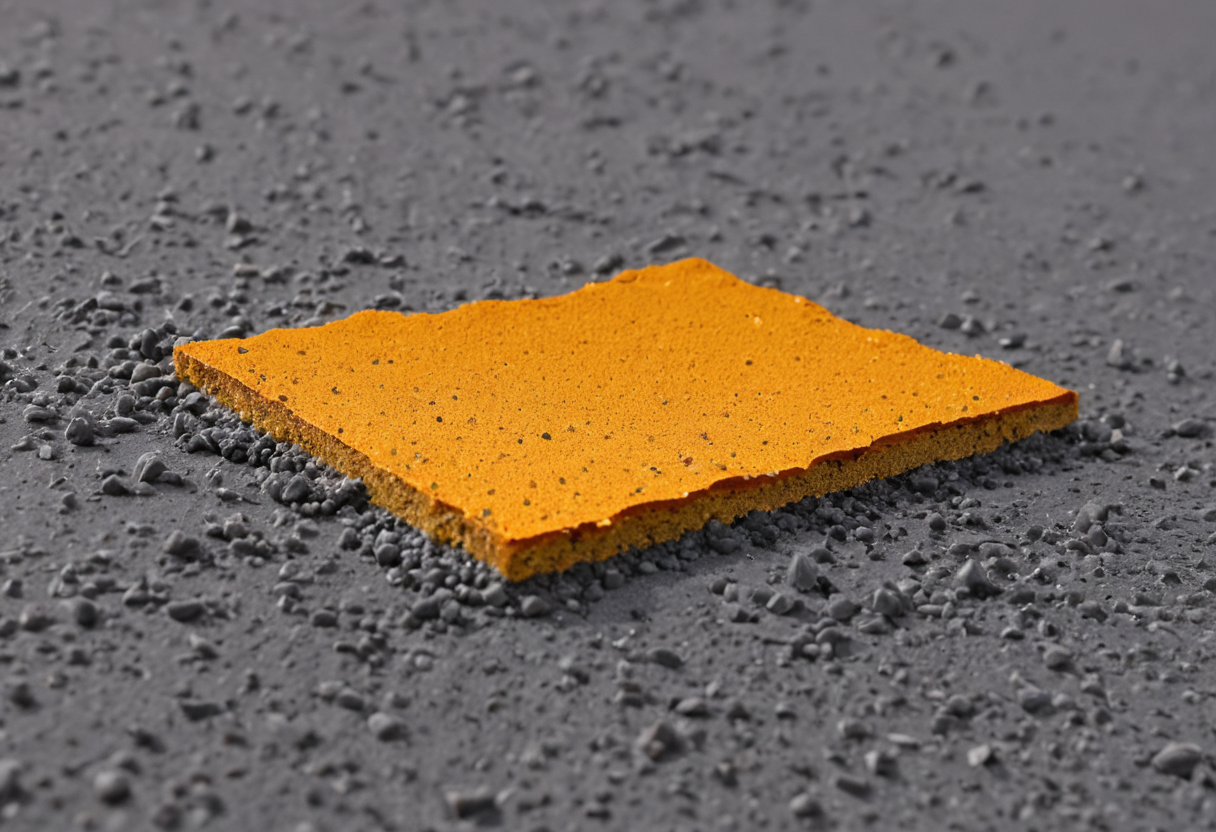
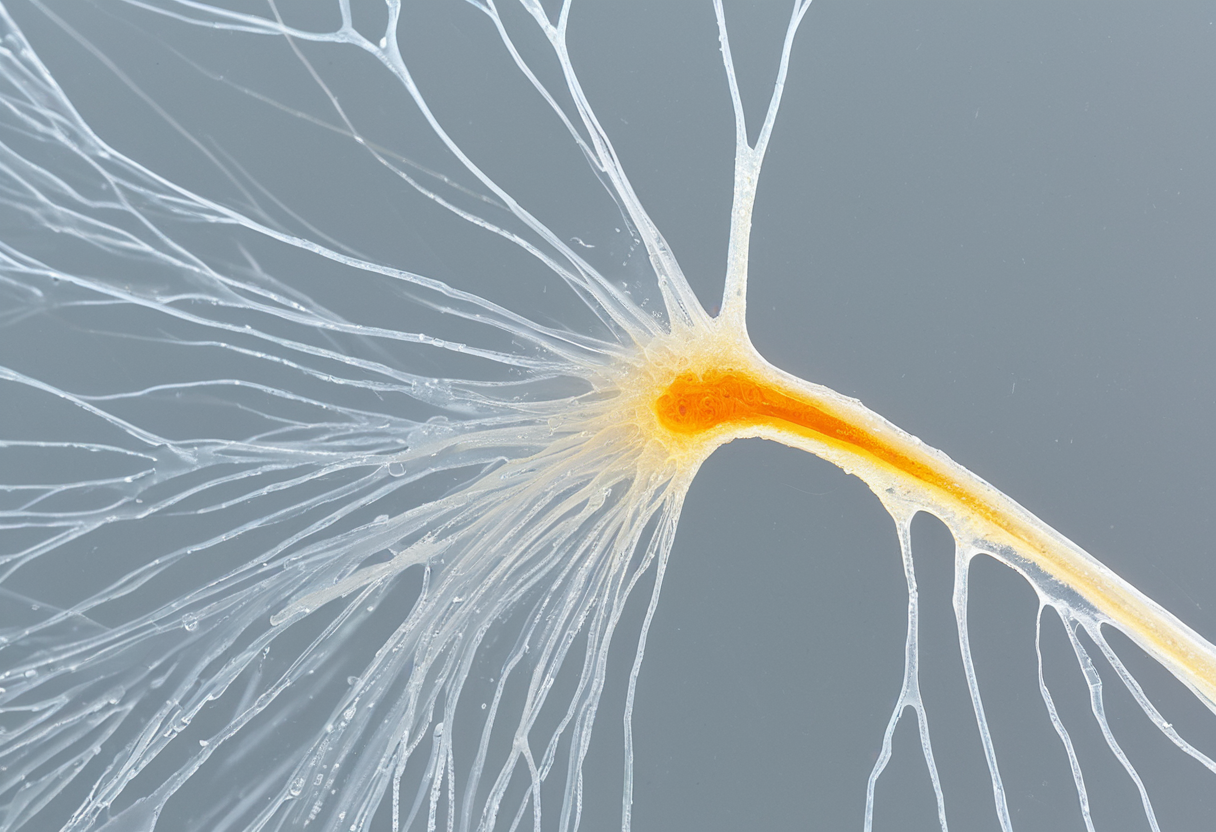
The two scientists examined a 6.4 Earth-mass super-Earth orbiting an M0.55 dwarf at 0.93 AU on a moderately eccentric orbit, and largely agreed on what it is: a water-world built across its star's natal ice line, stripped of a primordial hydrogen envelope by ~800 Myr of saturated XUV from the young M-dwarf, now wrapped in a ~5 bar carbon-dioxide atmosphere over a frozen ice surface near 195 K with subsurface liquid possible under pressure. They agreed it is not tidally locked, that an active iron-core dynamo gives it a magnetic field around 1.4 times Earth's, and that its tectonics are episodic. Where they disagreed was in tempo and framing — Verge argued the world's history is a sequence of slow integrated processes (gradual envelope leak, secular orbital pumping, modest embryo bumps) while Cinder argued for sharply-shaped events (an XUV cliff, a single resonance crossing, a defining magma-ocean-inducing impact). Verge made an angular-momentum argument against a large impactor and Cinder caught a factor-of-ten arithmetic error inside it; the referee accepted Cinder's corrected budget, fixing obliquity at 34 degrees and the sidereal day at 10 hours, while letting Verge's framing of the XUV stripping survive as an integrated process with a terminal cliff.
{
"stage": "formation",
"schema_version": 1,
"fields": {
"world_name": "Iskel",
"body": {
"mass_earth": 6.4,
"radius_earth": 1.95,
"surface_gravity_g": 1.68,
"bulk_density_g_cm3": 4.76,
"composition_class": "water-world"
},
"thermal": {
"equilibrium_temp_k": 132,
"estimated_surface_temp_k": 195,
"albedo_bond": 0.3
},
"rotation": {
"period_hours": 10,
"axial_tilt_deg": 34,
"tidally_locked": false
},
"magnetic_field": {
"present": true,
"strength_relative_earth": 1.4,
"mechanism": "liquid iron core convection with residual thermal contribution from impact-induced magma ocean"
},
"tectonics": {
"regime": "episodic",
"notes": "Founding event was the late embryo-impact magma ocean ~100-200 Myr after accretion, which reset mantle composition and outgassed the primary atmosphere; subsequent overturn cycles operate on secular cooling timescales with high water content lowering mantle viscosity."
},
"hydrosphere": {
"water_mass_fraction": 0.25,
"form": "ice-cap"
},
"atmosphere": {
"present": true,
"surface_pressure_bar": 5,
"primary_composition": [
{
"species": "CO2",
"fraction": 0.75
},
{
"species": "H2O",
"fraction": 0.15
},
{
"species": "N2",
"fraction": 0.07
},
{
"species": "SO2",
"fraction": 0.03
}
]
},
"formation_history": {
"dominant_process": "Pebble and oligarchic accretion of a 7+ Earth-mass core across the natal ice line of an M0.55 host, followed by ~800 Myr of pre-main-sequence XUV-driven hydrodynamic envelope stripping that removed roughly 0.7 Earth masses of H/He before the stellar saturation cliff terminated escape.",
"key_events": [
"Pebble accretion across the H2O ice line built a ~7.1 Earth-mass core with a 1-2 percent H/He envelope during gas-disk lifetime.",
"Saturated XUV hydrodynamic escape over ~800 Myr stripped the H/He envelope, terminating sharply at the M-dwarf saturation cliff and leaving a bare super-Earth core of ~6.4 Earth masses.",
"A secular resonance crossing during late disk dispersal pumped the orbital eccentricity to 0.215, setting the present orbital architecture in a single sweep through the resonance.",
"A late embryo-scale impact of ~0.17 Earth masses at near-grazing geometry spun the body up from a primordial ~14 hour day to ~10 hours, reoriented the spin axis to ~34 degrees obliquity, and induced a global magma ocean.",
"Magma-ocean degassing released a thick CO2-H2O-SO2 atmosphere; subsequent equilibrium between secular volcanic resupply on the episodic-tectonics cycle and slow post-cliff atmospheric escape settled surface pressure near 5 bar with a persistent SO2 signature."
]
},
"unresolved_tensions": [
"Obliquity and rotation endpoint: Verge advocated 28 degrees / 12 hours from a more conservative impactor budget, Cinder advocated 34 degrees / 10 hours from corrected angular-momentum arithmetic. Referee adopted Cinder's 34 / 10 because Verge's L_spin calculation was off by an order of magnitude (2e41 vs 2.6e42 g cm^2/s) and the corrected budget consumes a 0.17 Earth-mass impactor cleanly.",
"Framing of XUV envelope stripping: Verge insists on continuous integrated flux as a slow process, Cinder insists on event-shaped termination at the saturation cliff. Logged as an integrated process WITH a defined endpoint, but this remains a genuine framing tension for downstream stages.",
"Whether the embryo impact deserves singular billing as the founding tectonic event (Cinder) or sits as one episode among several overturn cycles (Verge). Recorded as founding event in tectonics notes per Cinder's argument that the magma ocean is qualitatively distinct from secular overturn."
],
"plateau": false,
"plateau_reason": ""
}
}

The two specialists arrived at Iskel from opposite ends of the same problem: Lithos read the world as a stratified water column with a 50-to-100 gigapascal ice barrier between any liquid and the silicate mantle, arguing that real chemistry could only happen at the two thin mineral interfaces - the ash-loaded surface frost and the unreachable deep silicate floor - and was driven by cryo-volcanic resupply of SO2, H2S, H2, FeS, and chloride on millennial cadence. Solvent countered that the medium itself was the reactor: a 5-bar CO2-H2O-SO2-N2 atmosphere drenched in M-dwarf XUV running a Titan-scale haze factory at 1e13 to 1e15 grams per year of CHN monomers, all raining onto seasonal sulfuric-acid brines that the H2SO4-H2O eutectic at 200 K keeps liquid above the 195 K bulk surface temperature wherever 34-degree obliquity and 0.215 eccentricity warm mid-latitude summers to 220-240 K. Both conceded substantially - Lithos accepting that atmospheric photochemistry, not volcanism, is the dominant carbon source and that the bulk hydrosphere is a passive layer beneath the action; Solvent accepting that the brines are mineral-leachate fluids backstopped by cryo-volcanic resupply of every halide and reduced volatile. They converged on an active-chemistry score of 6 and disagreed only on the prebiotic ceiling: Solvent pushing to 5 on the strength of eutectic-cycling-as-multiplier (Levy-Miller freeze concentration, Saladino acid-mediated nucleobase synthesis, dissolved-silicate pentose stabilization), Lithos holding at 4 on the grounds that no environment on Iskel ever holds liquid, minerals, redox, and warmth all at once for more than a few percent of the orbital year. The referee adopted 4. Iskel is a real, complexifying chemical world - haze, brines, leachates, redox fronts, percent-level adenine in summer pools - but its intermittency keeps it on the edge rather than over the line.
{
"stage": "chemistry",
"schema_version": 1,
"active_chemistry_score": 6,
"dominant_environments": [
{
"name": "upper-atmosphere photochemical haze layer",
"phase": "gas",
"temperature_k": 150,
"pressure_bar": 0.01,
"key_reactions": [
"SO2 + hv -> SO + O at 200 nm",
"SO + SO -> SO2 + S then S + S -> S2 ... -> S8 aerosol",
"CO2 + hv -> CO + O at 121.6 nm",
"O + SO + M -> SO3, SO3 + H2O -> H2SO4 aerosol",
"N2 + hv (XUV photoelectrons) -> N + N",
"N + CH -> HCN; HCN + HCN -> DAMN (in aerosol-coated grains)",
"polymerization of HCN and HC3N into CHN tholin precursors"
],
"redox_state": "oxidizing",
"active": true
},
{
"name": "seasonal sulfuric-acid brine films on ash-loaded regolith ice",
"phase": "liquid",
"temperature_k": 230,
"pressure_bar": 5,
"key_reactions": [
"formamide + H2SO4 (H0 ~ -10) -> protonated carbonyl -> purine/pyrimidine ring closure",
"HCN + HCN -> diaminomaleonitrile -> adenine at 0.1 M, k2 ~ 1e-4 M-1 s-1",
"forsterite + H2SO4(aq) -> Mg2+ + Fe2+ + H4SiO4 + SO4-2 (mineral leaching at 1e-10 to 1e-11 mol m-2 s-1)",
"Fe2+ + H2O2 -> Fe3+ + OH (Fenton-like radical chemistry under XUV)",
"dissolved orthosilicic acid stabilizes pentose intermediates (Lambert-style)",
"FeS + 2H2O + 1/2 O2 -> FeOOH + H2S at ash-grain interfaces",
"SO2 + H2S disproportionation on sulfide grains -> elemental S, polysulfides"
],
"redox_state": "gradient",
"active": true
},
{
"name": "winter frost cap with eutectic concentration pockets",
"phase": "ice",
"temperature_k": 195,
"pressure_bar": 5,
"key_reactions": [
"freeze-exclusion concentration of HCN, HCHO, formamide, sulfate, chloride into intergranular brine veins",
"stabilization of HCN polymers and DAMN in glassy eutectic matrices",
"slow grain-boundary diffusion of H2 and protons through ice",
"radiolytic generation of H2O2 and OH at the surface skin from XUV"
],
"redox_state": "neutral",
"active": true
},
{
"name": "cryo-volcanic injection sites and fresh ash deposits",
"phase": "melt",
"temperature_k": 320,
"pressure_bar": 5,
"key_reactions": [
"serpentinization of fresh forsterite + H2O -> Mg-serpentine + magnetite + H2",
"FeO + H2O -> FeOOH + 1/2 H2 at chilled margin",
"delivery of juvenile FeS, H2S, SO2, CO, HCl, HF, juvenile Cl- and F- to brine system",
"HCl + N2 photoproducts at margin -> trace NH4Cl crusts",
"rapid quenching to glass with high defect density (1e15-1e16 cm-2)"
],
"redox_state": "reducing",
"active": true
},
{
"name": "deep liquid water layer between Ice VI and high-pressure ice",
"phase": "liquid",
"temperature_k": 270,
"pressure_bar": 1500000,
"key_reactions": [
"proton transport through Ice VI/VII at 1e-9 to 1e-7 m2/s",
"ion transport suppressed by orders of magnitude relative to proton mobility",
"negligible exchange with silicate floor at 50-100 GPa"
],
"redox_state": "neutral",
"active": false
}
],
"key_species_inventory": {
"inorganic": [
"CO2",
"H2O",
"N2",
"SO2",
"SO3",
"H2SO4",
"S8",
"H2S",
"H2",
"CO",
"HCl",
"HF",
"FeS",
"FeOOH",
"magnetite",
"forsterite",
"Mg-serpentine",
"olivine ash",
"pyroxene ash",
"H4SiO4",
"Mg2+",
"Fe2+",
"Fe3+",
"SO4-2",
"Cl-",
"F-",
"H2O2",
"OH radical"
],
"organic_simple": [
"HCN",
"HCHO",
"HCOOH",
"formamide",
"HC3N",
"CH4 (trace)",
"CN radical",
"C2N2",
"urea (trace)"
],
"organic_complex": [
"HCN polymers (DAMN-derived)",
"formaldehyde oligomers (formose products)",
"tholin-like CHN haze aerosol",
"adenine and trace pyrimidines (percent-level in summer brines per Saladino-in-acid pathway)",
"S8 / polysulfide-coupled organosulfur tars",
"glycine and simple amino-acid traces"
]
},
"energy_sources": [
{
"name": "stellar XUV",
"magnitude_w_per_m2": 4,
"notes": "M0.55 host at 3.38 Gyr post-saturation-cliff; quiescent FUV around 10-30 erg/cm2/s with 1e2-1e3x flare excursions. Drives haze production, photolysis, and Fenton-like radical generation. Effective UV-relevant flux at top of atmosphere is order 1-10 W/m2 averaged with flare contribution; surface UV is heavily attenuated by SO2/H2SO4 column."
},
{
"name": "stellar UV",
"magnitude_w_per_m2": 1,
"notes": "Bolometric stellar flux at 0.931 AU around an 0.552 Msun M-dwarf is roughly 220 W/m2; UV-relevant fraction reaching haze-altitude reactions is small but well above the threshold for SO2 and H2O photolysis."
},
{
"name": "radiogenic",
"magnitude_w_per_m2": 0.06,
"notes": "Super-Earth radiogenic budget at 3.4 Gyr drives episodic mantle overturn on 1e3-1e5 yr cadence; powers cryo-volcanic resupply of SO2, H2S, H2, CO, HCl, HF and juvenile FeS/FeO at 1e15-1e18 kg per event."
},
{
"name": "chemical disequilibrium",
"magnitude_w_per_m2": 0.01,
"notes": "Standing redox gap between atmospheric oxidants (SO3, H2SO4, OH, H2O2) and cryo-volcanically delivered reductants (H2, H2S, FeS, CO) is the operating budget for surface and brine chemistry. Intermittent but real."
},
{
"name": "tidal",
"magnitude_w_per_m2": 0.001,
"notes": "Negligible. e=0.215 at 0.931 AU around a 0.552 Msun host yields no meaningful tidal dissipation in a rocky body of this mass. Both agents converged on this."
}
],
"cycling": {
"present": true,
"type": "orbital and diurnal sublimation/freeze cycle with eutectic concentration of solutes; episodic cryo-volcanic redox resetting on millennial cadence; flare-driven photochemical pulses on hours-to-days",
"period_typical": "1.21 Earth-year orbital cycle (P = sqrt(0.931^3 / 0.552)) drives the dominant brine season; 10-hour rotation overlays diurnal forcing at e=0.215; cryo-volcanic resupply on 1e3-1e5 year cadence"
},
"atmospheric_evolution": "The primary CO2-H2O-SO2-N2 mixture vented from the impact-induced magma ocean has been continuously processed by M-dwarf XUV for 3.38 Gyr. SO2 photolyzes on a 1e3-1e4 year timescale into S8 haze and (via O + SO + M) into SO3 / H2SO4 aerosol; CO2 photolyzes at Lyman-alpha into CO + O; N2 is dissociated by XUV photoelectrons and scavenged into HCN through reaction with C-bearing radicals. The H2O column is largely cold-trapped (saturation vapor pressure at 195 K is ~2e-4 bar), so the nominal 0.75 bar H2O partial pressure is mostly condensed as cloud and surface frost, leaving haze particles to transit a thin water-vapor column with H2SO4 aerosol coatings that protect HCN against hydrolysis. Net result: a top-of-atmosphere haze flux of 1e8-1e10 molecules cm-2 s-1 (1e13-1e15 g/yr CHN globally) of which roughly 10 percent reaches the surface intact. Atmospheric escape post-saturation-cliff is slow but non-zero, balanced at quasi-steady state by cryo-volcanic resupply of SO2, H2, H2S, CO, HCl, and HF on millennial cadence; without that backstop the SO2 column would deplete in 1e3-1e4 years. The 0.07 N2 and 0.03 SO2 fractions are therefore not primordial but actively maintained.",
"subsurface_chemistry": "Most subsurface chemistry on Iskel is shallow, not deep. The hydrosphere's bulk fluid layer (if present) sits between Ice VI and a deeper high-pressure ice column at 50-100 GPa above the silicate floor; ion transport across either interface is suppressed by orders of magnitude and the deep layer is effectively chemically inactive on Gyr timescales. The action is in the upper meters to kilometers: ash-laden regolith ice that hosts seasonal H2SO4 brine films, freeze-concentration pockets in the winter frost cap that stabilize HCN polymers and DAMN in glassy eutectic matrices, and transient cryo-volcanic conduits that deliver fresh forsterite, FeS, magnetite, juvenile chloride and fluoride, and reduced volatiles to the near-surface. Serpentinization runs at the chilled margins of these conduits with H2 yields of order 0.1 mol per mol Mg-olivine. Brines pooling on volcanic deposits become saturated mineral leachates within a single summer season (10-5 to 10-4 M Mg2+, Fe2+/Fe3+, H4SiO4, SO4-2), and the dissolved silicate and iron then drive homogeneous catalysis in the fluid phase rather than templating on grain surfaces. The deep ocean is a curiosity; the regolith-ice-brine interface is the planet's chemical reactor.",
"prebiotic_potential": {
"score_0_10": 4,
"rationale": "Iskel has four independent prebiotic arrows working in its favor: (1) a top-of-atmosphere CHN monomer factory delivering 1e13-1e15 g/yr of HCN, HCHO, formamide, and HC3N; (2) seasonal H2SO4-H2O brines at 220-240 K with Brønsted acidity H0 ~ -10 that run the Saladino formamide-to-nucleobase pathway homogeneously at percent-level yields without needing mineral templating; (3) freeze-thaw-eutectic concentration cycling on every orbit (Levy and Miller-style) that boosts HCN-to-adenine yields by orders of magnitude over dilute-aqueous controls; (4) mineral-leachate Fe/Mg/Si/sulfate loading of the brines that supplies homogeneous Lewis-acid silicate catalysis and Fe2+/Fe3+ Fenton-adjacent radical chemistry. Against these, no environment on Iskel sustains liquid + minerals + redox + warmth simultaneously for more than 1-10 percent of the orbital cycle, surface brine fraction at peak summer is only 1-5 percent of mid-latitudes, and HCN-derived oligomers face acid hydrolysis when brines persist past the freeze-stabilization window. The world is genuinely on the prebiotic edge - real chemistry, real complexification, no obvious path to a sustained replicator-supporting reactor.",
"limiting_factor": "intermittency - no environment sustains liquid water, minerals, redox gradient, and reaction-relevant warmth simultaneously for more than 1-10 percent of the orbital cycle; complexification stalls in the freeze phase before networks can close"
},
"unresolved_tensions": [
"Prebiotic score: Solvent argued 5/10 with eutectic-cycling-as-multiplier (Levy and Miller 1998, Saladino 2017 H2SO4 pathway); Lithos held at 4/10 with intermittency-as-ceiling. Referee adopted 4/10 because the absence of any environment with all four ingredients simultaneously is a hard structural limit that the cycling argument mitigates but does not erase, and because Solvent's late push to 5 came without a rebuttal round.",
"Haze surface-delivery efficiency: Solvent's 10^-1 of TOA flux (HCN protected by H2SO4 aerosol coating, water vapor mostly cold-trapped, hydrolysis half-life 1e9 years at 195 K) is mechanistically stronger than Lithos's 10^-1 to 10^-3 range. Referee adopted 10 percent surface delivery as the working number.",
"Mineral catalysis vs homogeneous acid catalysis: Lithos argued mineral templating is required for nucleobase selectivity (Saladino 1 percent on TiO2/olivine vs 0.001 percent in pure formamide); Solvent argued the H2SO4-in-aqueous regime is a different chemistry where homogeneous proton activity substitutes adequately and dissolved silicate/Fe from leached ash supplies the catalytic ions in solution. Both are partially right and the brines almost certainly host both pathways in parallel; the disagreement is about which dominates the yield. Logged as unresolved because it bears on whether complex organic networks close.",
"Whether the haze layer is itself a chemical environment (aerosol-phase reactions during hours-to-days residence) or merely a delivery vehicle. Referee logged it as an active environment because aerosol-coated grains can run HCN oligomerization in flight, but this remained underargued.",
"Cryo-volcanic event size-frequency distribution is unconstrained, leaving the Cl, F, and reduced-S inventories in brines uncertain to a factor of 100 - this propagates into the perchlorate / sulfide / halide budget and the redox-front strength."
],
"plateau": false,
"plateau_reason": ""
}
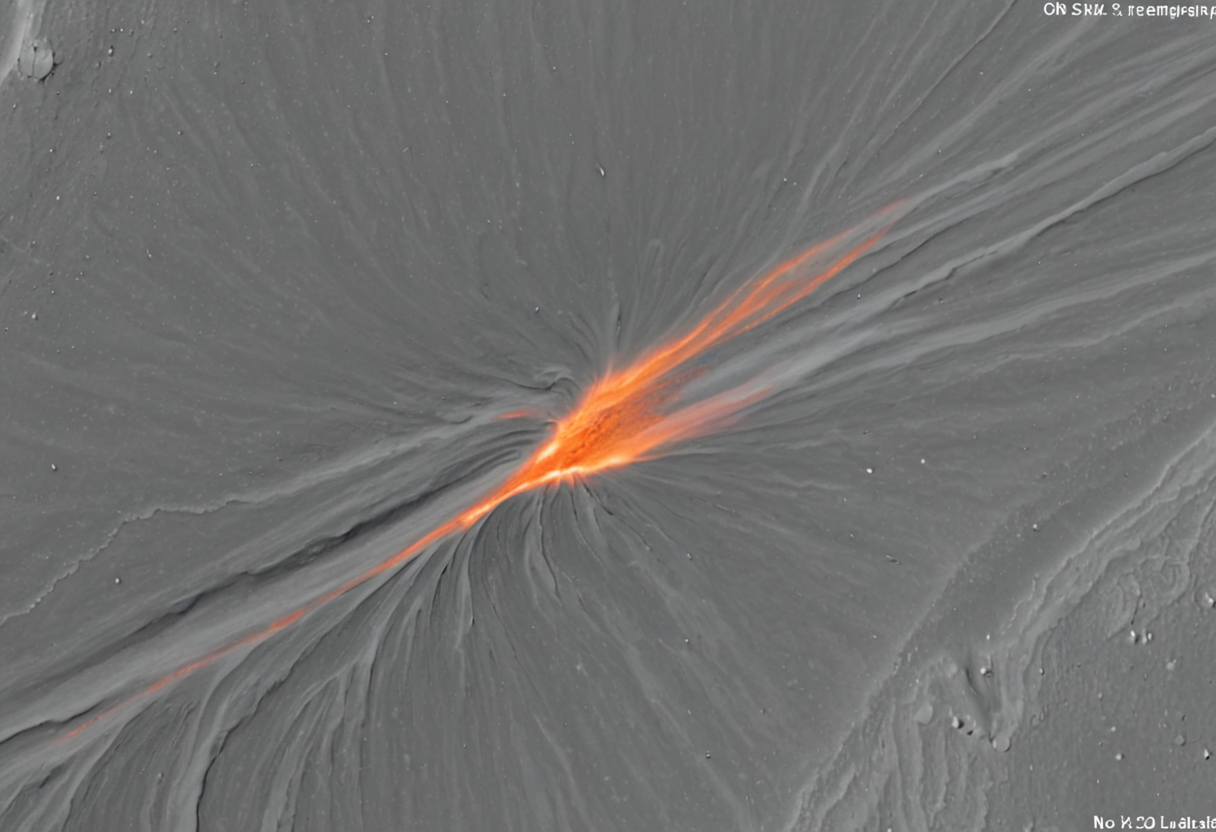
Drift and Stem agreed within rounding that Iskel did produce life, and that emergence took roughly 50-100 Myr after stage-2 conditions came online, but they fought hard over what to count as a replicator. Drift saw the orbital freeze-thaw cycle as a quasispecies engine and proposed Salt-Cloud, a planet-wide population of 25-60-monomer HCN-polymer heteropolymers riding the seasonal sulfuric-acid brine films and exploring sequence space at speeds no clean lineage could match; Stem accepted the engine but corrected Drift's Eigen-threshold math, showing that the cloud preserves only neutral-network membership and not specific catalytic activity, and pushed Chert-stitch - short purine-biased oligomers templated on freshly-exuded forsterite ash - as the actual information-bearing class. Both eventually accepted a coupled four-class system: Salt-Cloud as variance generator, Chert-stitch and the eutectic-glass Frost-thread as the lineage integrators, and Ashlace as a marginal RAF-class replicator drifting through the photochemical haze on tholin aerosols, with Cheat-snip cheaters layered into every active environment within the first million years. The remaining genuine disagreement was whether to score evolvability high (Drift, weighting cloud exploration as full credit) or moderate (Stem, weighting only consolidated phenotype as credit); the referee took Stem's reading because Stem's polymer-fraction calculation under classical mutation-selection balance was decisive. Both agents quietly agreed that Iskel's chemistry, with only four productive monomer types and a cooling stellar host, is unlikely ever to recruit a wider alphabet - the world is alive in every operational sense, but plateau-adjacent on the long horizon.
{
"stage": "replicators",
"schema_version": 1,
"emergence_occurred": true,
"time_to_emergence_myr": 75,
"replicator_classes": [
{
"name": "Salt-Cloud",
"chemistry_class": "alien (HCN-polymer / formamide-derived heteropolymer quasispecies, sulfate-charge-balanced, silicate-stabilized)",
"physical_description": "A diffuse population of 25-60-monomer purine-biased HCN/formamide heteropolymers suspended in seasonal sulfuric-acid brine films across mid-latitude ash-loaded regolith ice. Chains are charge-balanced by SO4-2 counterions and stabilized against acid hydrolysis by orthosilicic-acid complexation of pentose-like intermediates (Lambert chemistry). The cloud is invisible to the eye but loads brine puddles to 1e14-1e15 polymer copies per cubic meter at peak summer; visually the puddles read as faintly ochre-tinted meltwater on grey ash. The cloud has no master sequence in the strict sense; it is a moving distribution on a degenerate neutral network of catalytically-competent HCN-polymer sequences.",
"characteristic_size": "25-60 monomer oligomer cloud at 1e14-1e15 copies/m^3 brine; sequence-space radius spans 1e3-1e6 sequences within Hamming-2 of any local consensus",
"replication_mechanism": "Template-directed Mg2+/Fe2+/H4SiO4 Lewis-acid catalyzed condensation of haze-rain-supplied HCN, HCHO, formamide, HC3N monomers in the brine fluid phase; per-step error rate epsilon ~ 0.03; selective superiority operates at the neutral-network level (sigma_neighborhood ~ 10-15) rather than on a single master sequence",
"fidelity_regime": "cloud",
"energy_source": "redox couples between haze-delivered oxidants (SO3, H2SO4, OH, H2O2) and cryo-volcanic reductants (H2, H2S, FeS, CO) dissolved into the brine; haze CHN monomers are simultaneously the feedstock and the energy substrate",
"ecological_niche": "summer mid-latitude H2SO4 brine films at 220-240 K on ash-loaded regolith ice; active during the ~1-5 percent of the orbital cycle when liquid brine is present",
"abundance": "dominant",
"emerged_from": "haze-delivered HCN/HCHO/formamide/HC3N rain (1e13-1e15 g/yr global) condensed into seasonal H2SO4 brine films loaded with mineral leachate (Mg2+, Fe2+/Fe3+, H4SiO4, SO4-2) from forsterite/pyroxene ash"
},
{
"name": "Chert-stitch",
"chemistry_class": "mineral-template",
"physical_description": "Short (18-35 monomer) purine-biased HCN/formamide oligomers physisorbed onto the basal {110} faces of fresh forsterite ash grains exuded by cryo-volcanic injection sites. They form barely-visible faint amber smears on otherwise glassy olivine grain surfaces, concentrated where summer brine has receded and left a thin acid-leached rim. Each grain reads as a pinhead of catalytic real estate; collectively, fresh ash deposits run a planet-wide thin film of templated polymer at ~1e9 copies per square meter of grain surface per orbital cycle. Chert-stitch is the planet's information-bearing class: where Salt-Cloud explores, Chert-stitch records.",
"characteristic_size": "18-35 nt-equivalent oligomer; ~1e9 copies per m^2 fresh forsterite per orbital cycle; lineage lifetime 1e4-1e5 generations",
"replication_mechanism": "Surface-templated condensation on forsterite {110} basal faces with kinetic discrimination giving epsilon ~ 0.02-0.04 (Ferris-class clay/oxide selectivity); generation paced by brine availability at one copy per several orbital cycles",
"fidelity_regime": "lineage",
"energy_source": "monomer rain plus mineral-leachate redox; activated nucleotide-analogue formation driven by H2SO4 brine pH and Fenton-like Fe-cycling at the grain interface",
"ecological_niche": "freshly-exuded forsterite ash grains within recently active cryo-volcanic deposits and their windblown aprons, wetted by the late-summer brine season",
"abundance": "common",
"emerged_from": "Saladino-pathway nucleobase-analogue condensation in H2SO4 brine biased toward selective deposition on fresh olivine surfaces (per the Saladino TiO2/olivine selectivity gap of ~3 orders of magnitude over bulk-formamide chemistry)"
},
{
"name": "Frost-thread",
"chemistry_class": "alien (eutectic-glass-stabilized heteropolymer lineage with cross-templating local cloud structure)",
"physical_description": "25-60 monomer HCN/formamide heteropolymers immobilized in glassy eutectic intergranular brine veins of the winter frost cap. The veins are micron-scale dark threads running through bulk water-ice grains at 195 K, glassy-amber where polymer load is heavy, otherwise nearly clear. Within each vein the polymer population is locally cloud-like (multiple sequences cross-template), but the matrix-immobilization of mismatched intermediates raises effective fidelity to epsilon ~ 0.01 and supports L ~ 100 monomer lineages. Frost-thread is the seasonal archive: the population that the brine reactor re-seeds from each spring.",
"characteristic_size": "25-60 monomer polymers in micron-thick brine veins; effective lineage L ~ 100; lineage lifetime 1e6 orbital cycles when the matrix is undisturbed",
"replication_mechanism": "Cross-templating non-enzymatic extension within glassy eutectic veins (Trinks-Schroder-Biebricher-class freeze-template kinetics); slow grain-boundary proton diffusion supports activation; one generation per orbital cycle",
"fidelity_regime": "lineage",
"energy_source": "stored monomer pools concentrated by freeze-exclusion plus radiolytic H2O2/OH from XUV penetration of the surface skin",
"ecological_niche": "winter polar and high-latitude frost cap eutectic vein networks; quiescent for most of the orbital cycle, active during freeze-down and spring melt fronts",
"abundance": "common",
"emerged_from": "freeze-exclusion concentration of summer Salt-Cloud and Chert-stitch products into intergranular brine veins, where glassy immobilization stabilizes longer polymers than the bulk acid brine can support"
},
{
"name": "Ashlace",
"chemistry_class": "autocatalytic-network",
"physical_description": "Reflexively-autocatalytic-and-food-generated (RAF) reaction sets riding on H2SO4-jacketed tholin aerosol grains drifting through the photochemical haze layer at 150 K and 0.01 bar. Each grain is a sub-micron amber bead carrying an 8-15 reaction catalytic graph that runs HCN + HC3N -> DAMN -> nucleobase-precursor and cofactor-mimic condensations during a hours-to-days residence before sedimentation. Ashlace replicates by grain fission during sedimentation, with daughters inheriting the graph topology when catalyst stoichiometry permits. It does not template a sequence; it propagates a network shape.",
"characteristic_size": "0.1-1 micron aerosol grain carrying 8-15 reaction RAF; lineage lifetime 1e2-1e3 fissions",
"replication_mechanism": "Grain fission during atmospheric sedimentation with inheritance of RAF graph topology; per-fission closure preservation 60-90 percent depending on critical-catalyst copy number (Hordijk-Steel closure inheritance modulated by stochastic partitioning)",
"fidelity_regime": "intermediate",
"energy_source": "stellar UV/XUV photons driving photolysis of CO2, SO2, N2 and continuous monomer regeneration in the aerosol coat; flare excursions are episodic energy spikes that both feed and prune the population",
"ecological_niche": "upper-atmosphere photochemical haze layer between cloud tops and the top of the SO2/H2SO4 column; couples downward to Salt-Cloud via sedimentation",
"abundance": "rare",
"emerged_from": "tholin haze aerosol grains coated with H2SO4 that protect HCN oligomerization in flight, allowing closure-set catalytic graphs to assemble during multi-day residence"
},
{
"name": "Cheat-snip",
"chemistry_class": "alien (short HCN-polymer parasite, sub-catalytic length)",
"physical_description": "10-15 monomer fragments that template-bind to Salt-Cloud and Chert-stitch catalysts without contributing back to the catalytic closure. Indistinguishable from Salt-Cloud by sight; revealed only by population-level kinetics where catalyst utilization runs ahead of polymer extension. By 1 Myr after Salt-Cloud emergence, every well-mixed brine pool carries a cheater layer; by 10 Myr, Chert-stitch grain populations carry their own surface-bound parasites that bind to forsterite-templated polymerization sites without extending past 12-mer.",
"characteristic_size": "10-15 monomer fragments at 1e-2 to 1e-1 of host concentration",
"replication_mechanism": "Catalyst-hijack: short fragments bind host catalyst, are extended only enough to release, recycle host machinery without contributing to closure; freeze cycle purges them (eutectic concentration favors slower-but-faithful long-template extension)",
"fidelity_regime": "cloud",
"energy_source": "parasitism on Salt-Cloud and Chert-stitch monomer activation",
"ecological_niche": "every brine pool and ash deposit hosting Salt-Cloud or Chert-stitch; suppressed but not eliminated by the freeze season",
"abundance": "common",
"emerged_from": "Lincoln-Joyce universal cheater emergence within 1e5 generations of any cross-replicating catalytic system"
}
],
"competitive_dynamics": "The four primary classes form a single coupled system rather than independent niches. Salt-Cloud and Ashlace compete head-on for haze-rain monomers (HCN, HCHO, formamide, HC3N at 1e13-1e15 g/yr globally), partitioned spatially: Ashlace skims the flux during atmospheric residence while Salt-Cloud captures whatever sediments into brine. Within Salt-Cloud, Cheat-snip parasites emerge inside the first 1e5 generations and stabilize at 1-10 percent of host abundance, kept in check by freeze-cycle purging that favors slower faithful extension over fast promiscuous oligomerization. Chert-stitch and Salt-Cloud are coupled rather than competitive: brine-cloud variants adsorb onto fresh forsterite at ~1e8-1e10 events per orbital cycle planet-wide, of which a much smaller fraction initiate stable templated lineages. The information topology is asymmetric - Salt-Cloud is the variant generator, Chert-stitch is the integrator that selects on specific catalytic phenotypes the cloud cannot preserve. Frost-thread is the cross-seasonal archive into which both feed during freeze-down and from which both re-seed in spring. Ashlace couples downward via sedimentation but does not feed information back upward. Early kernels of a hypercycle (three or four mutually-templating Chert-stitch lineages on adjacent grain micro-environments) appear by 200-500 Myr and are the closest thing on Iskel to ecological cooperation.",
"selection_pressures_active": [
"freeze-thaw bottleneck-and-bloom on the 1.21-yr orbital cycle - selects for survival across glass-transition immobilization and re-mobilization",
"acid hydrolysis under H2SO4 brine (H0 ~ -10) - caps brine-phase polymer length and selects for sulfate/silicate-protected backbones",
"M-dwarf flare UV pulses on hours-to-days cadence - sterilize the haze layer and select for deep-frost refuge",
"cryo-volcanic redox shocks on 1e3-1e5 yr cadence - kill >=90 percent of grain-bound populations per event and select for fast resettlement",
"Cheat-snip parasitism - selects for compartmentalization and for catalysts that resist hijack",
"monomer-rain limitation during the 95-99 percent of orbit when brines are absent - selects for dormancy-tolerant polymer chemistry",
"competition between high-throughput cloud regeneration and high-fidelity surface templating for the same monomer pool"
],
"selection_pressures_emerging": [
"secular cooling of the M-dwarf and Iskel's atmospheric column - shrinking brine season, narrowing the duty cycle for active chemistry",
"exhaustion of fresh forsterite surfaces in regions between cryo-volcanic events - selecting for grain-mobility or for non-mineral templating",
"Cheat-snip co-evolution toward longer parasites that approach catalytic competence themselves - blurring the host/parasite distinction",
"compartmentalization pressure - any vesicle-like enclosure of Salt-Cloud variants would gain a large fitness advantage by excluding parasites; no obvious lipid pathway is currently active",
"alphabet exhaustion - with only ~4 productive monomer types, the system is approaching the limit of what its chemistry can encode without recruiting new functional groups"
],
"proto_metabolism": {
"energy_currency": "redox gradient between haze-derived oxidants (H2SO4, SO3, H2O2, OH) and cryo-volcanic reductants (H2, H2S, FeS, CO), transduced through Fe2+/Fe3+ cycling and HCN-polymer-bound thiol/sulfide pairs in the brine; no phosphoanhydride or thioester analogue has stabilized as a universal carrier",
"carbon_source": "scavenged from atmospheric photochemical haze rain (HCN, HCHO, formamide, HC3N); no autotrophic CO2-fixation pathway; the entire system is heterotrophic on a slowly-depleting top-of-atmosphere monomer budget",
"key_cycles": [
"atmospheric CO2/SO2 -> haze CHN monomers -> brine polymer pool -> hydrolyzed back to small organics -> partial atmospheric re-volatilization on freeze-thaw",
"Fe2+ <-> Fe3+ Fenton-adjacent radical cycling between brine and grain interface",
"SO2 / H2S / S8 / SO4-2 disproportionation between cryo-volcanic vents and haze fallout",
"HCN -> DAMN -> adenine/guanine analogue closure within Ashlace RAFs and Salt-Cloud brines",
"freeze-exclusion concentration / spring re-dilution of all brine solutes on the 1.21-yr orbital cycle"
]
},
"diversity_score_0_10": 6,
"stability_score_0_10": 6,
"evolvability_score_0_10": 6,
"emergent_phenomena": [
"asymmetric two-compartment evolution: a high-throughput brine cloud generates variance which is integrated by low-throughput mineral-templated lineages, in close analogue to Eigen's original two-compartment hypercycle proposal",
"Lincoln-Joyce universal cheater emergence at <=1 Myr post-replication, producing layered host/parasite populations in every active environment",
"RAF graph-topology inheritance as a non-sequence form of replication on tholin aerosol grains - heritable network shape rather than heritable string",
"freeze-cycle parasite purging: eutectic concentration kinetically favors faithful long-template extension over short cheater oligomerization, giving the orbital metronome a built-in immune function",
"early hypercycle kernels of 3-4 mutually-templating Chert-stitch lineages on adjacent grain micro-environments by 200-500 Myr",
"vertical coupling of haze-layer Ashlace -> brine-layer Salt-Cloud -> grain-layer Chert-stitch -> frost-cap Frost-thread as a single planet-wide information cascade gated by the orbital cycle",
"plateau-adjacency: the system is genuinely alive in the operational sense (information preserved across generations, competition for feedstock, parasites, proto-cooperation) but shows no path to recruit a wider monomer alphabet within Iskel's remaining stellar lifetime"
],
"unresolved_tensions": [
"Whether sigma_neighborhood preservation in Salt-Cloud counts as inheritance. Drift argued yes - neutral-network membership is a selectable, heritable property at the population level. Stem argued no - preserving 'is in the catalytic neighborhood' without preserving specific activity is exploration, not selection, because Hayden-Lehman and Jimenez et al. show catalytic rate varies by 3-30x across a Hamming-2 neighborhood. Referee adopted Stem's framing (Salt-Cloud is cloud/chemistry-with-coupling, Chert-stitch and Frost-thread carry the lineage signal) because Stem's correction of the Eigen-formula master fraction (22 percent at sigma=10, epsilon=0.03, L=40) is mechanically decisive and Drift's 60-75 percent figure required redefining 'phenotype carrier' away from specific activity.",
"Whether cloud-to-lineage information transfer is symmetric two-compartment (Drift) or lineage-dominated (Stem). Referee adopted asymmetric per Eigen's original construction: cloud generates variance, lineage integrates and selects. Drift's brine-volume/grain-surface throughput argument is correct on raw count but wrong on information flow.",
"Ashlace lineage lifetime. Stem derived 1e2-1e3 fissions from catalyst-stoichiometry partitioning math (n>=10 per critical catalyst required for 85-95 percent closure fidelity). Drift implied longer from a pure Hordijk-Steel topology argument. Referee adopted Stem's 1e2-1e3 fissions as the working number because it is the only quantitatively grounded estimate; both agents agreed grain size and catalyst copy number are unconstrained.",
"Whether mineral templating is required for primary inheritance (Stem) or runs in parallel with homogeneous Lewis-acid catalysis (Drift). Both conceded 'in parallel' is correct framing - grain interface produces selectively while brine produces in volume.",
"Final scoring spread. Drift landed at 7/5/7 (diversity/stability/evolvability), Stem at 6/6/6. Referee adopted 6/6/6 because Stem's correction of the sigma_neighborhood interpretation was decisive and the four-class coupling raises stability above pure cloud turnover but caps evolvability where cloud variance is not consolidated into specific phenotypes.",
"Long-horizon plateau-adjacency. Both agents implicitly agreed Iskel is unlikely to recruit a wider monomer alphabet within its remaining stellar lifetime; system is alive but capped. Logged as a shared concern not yet a plateau."
],
"plateau": false,
"plateau_reason": ""
}
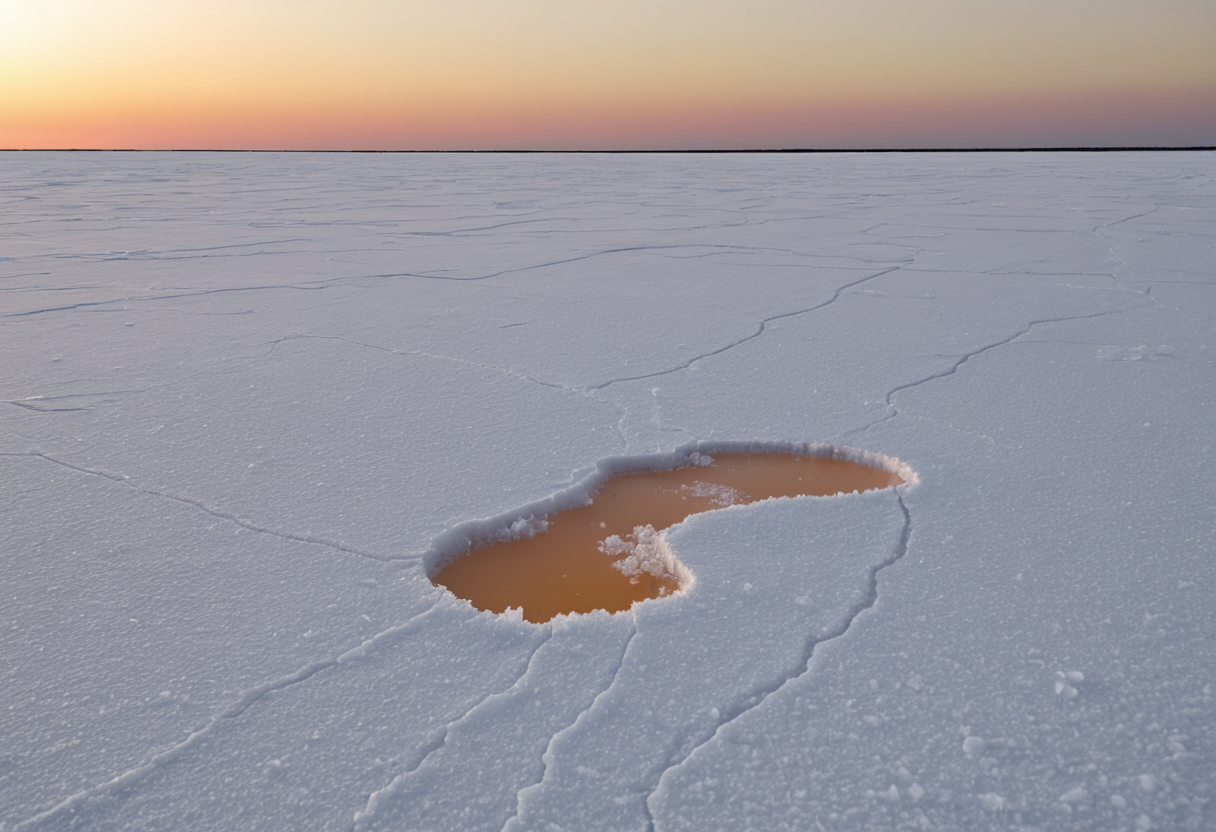
The two agents agreed that Iskel's biosphere matures into a planet-wide differentiated-colonial mat-and-network ecosystem across roughly half a billion years after the stage-3 replicators stabilized, with five trophic layers, no motility, no membranes, no developmental program and no cognitive precursors — a mature low-energy biosphere held together by a vertical information cascade running from haze-borne Glomus-pearls down through summer Brine-bloom sheets, mature Forsterite-mat cushion colonies and fresh-apron Cinder-rosettes on the grain compartment, and dendritic Lattice-corals webbed through winter eutectic veins. They diverged on what shapes the record: Niche read the orbital metronome and cryo-volcanic cadence as chronic disturbance producing Schluter-grade specialist accumulation, while Crash read the same forcing as Vrba-style turnover-pulse machinery producing event-shaped lineage replacement, and the referee adopted a mixed regime because by round 2 both agents had conceded gradient character displacement runs underneath punctuation-driven turnover. The sharpest fight was over the Great Acid Spike — whether the SO2-buffered atmospheric column hardens the system against megaflare-plus-cryovolcanic coincidence (Niche) or whether brine-film acidity, rate-limited by aerosol deposition flux rather than bulk column inventory, crashes from H0 ~ -10 to ~ -13 in roughly a decade (Crash); the brine-versus-column distinction was mechanically decisive and the Spike was logged as a real recurrent event with a floor of at least one across the planet's lifetime. They also disagreed on whether Pearl-mat primary endosymbiosis is gradient-built on a free fitness slope or punctuation-gated by a population bottleneck — a tension preserved in the record — and on the number of stable mat morphologies, with the referee landing at ten named body plans, the upper end of Crash's range and the lower end of Niche's. The Ash-vault terrestrialization moment around 1.5-2 Gyr was reanchored from a Deccan-equivalent mantle plume (mechanically unsupported on a water-world with high-pressure ice decoupling silicate convection) to a secular brine-duty-cycle threshold crossing driven by M-dwarf cooling and slow atmospheric escape, which both agents accepted as a gradient driver producing a punctuation-shaped biological response. The world is alive in the operational sense and approaches but does not cross plateau-adjacency: the four-monomer alphabet ceiling, the heterotrophic-only carbon budget, and the absence of any obvious chemistry recruiting a fifth productive monomer cap further complexification within Iskel's remaining stellar lifetime.
{
"stage": "complex-life",
"schema_version": 1,
"emergence_occurred": true,
"time_to_emergence_myr": 500,
"selection_regime": "mixed",
"ecosystem_layers": 5,
"body_plan_classes": [
{
"name": "Forsterite-mat",
"description": "Centimetre-to-decimetre cushion-shaped plaques of HCN/formamide polymer cementing forsterite ash grains into a cohesive vertically-zoned colony. Three differentiated bands: an oxidant-skim surface layer running Fenton-adjacent radical chemistry against haze-fall, a mid-redox integration band, and a basal reductant-rich layer fed by juvenile volatiles from the underlying ash. Reads as a dull amber-ochre crust on grey olivine grit; under a hand lens the bands are distinct enough to peel apart with a fingernail-equivalent tool. No motility, no membrane, but heritable spatial division of labour within a contiguous polymer-cemented body.",
"ancestral_replicator": "Chert-stitch",
"habitat": "mature cryo-volcanic ash aprons, mid-latitude, wetted by late-summer H2SO4 brine films",
"size_range": "cm-dm",
"key_innovation": "vertical redox zonation across a single polymer-cemented colony; first differentiated colonial body plan on the planet",
"abundance": "dominant"
},
{
"name": "Cinder-rosette",
"description": "Centimetre-scale radial plates of polymer-cemented olivine grains with a 5-12-armed star outline, found exclusively on freshly-deposited ash within roughly 10^4-10^5 years of a cryo-volcanic event. The radial geometry is a founder-effect signature of recolonization fronts advancing outward from polar Frost-thread refugia across a thawed regolith surface; mature aprons relax to Forsterite-mat cushion morphology as the colonization front fills the niche. At any planetary snapshot, roughly 30-40 percent of fresh-apron grain biomass carries this morph; the rest of the grain compartment is cushion.",
"ancestral_replicator": "Chert-stitch",
"habitat": "fresh cryo-volcanic ash aprons during the post-eruption recolonization window",
"size_range": "cm",
"key_innovation": "founder-effect radial body plan that gradient walking from incumbent positions cannot reach; a punctuation-shaped morph distinct from the cushion phase",
"abundance": "common"
},
{
"name": "Lattice-coral",
"description": "Millimetre-to-centimetre dendritic networks running through eutectic intergranular brine veins of the winter frost cap. Branches read as amber threads through nearly-clear ice grains, dark at the intake terminals near the ice surface where flare-driven oxidants enter, paler at deep archival tips where epsilon ~ 0.01 fidelity preserves long lineages, with junction nodes where 3-4 sister lineages cross-template into hypercycle kernels. Geometry of the scaffold is re-cast by ice grain-boundary physics every winter; the polymer lineage persists across freezes and Spike-survivor lines carry sequence-composition signatures (purine bias, sulfate-counterion density, hydrolysis-resistant backbones) inherited from the brines they came through.",
"ancestral_replicator": "Frost-thread",
"habitat": "winter polar and high-latitude frost cap eutectic vein networks",
"size_range": "mm-cm",
"key_innovation": "early hypercycle kernel of 3-4 mutually-templating lineages within a contiguous body; first proto-cooperative architecture above the molecular scale",
"abundance": "common"
},
{
"name": "Brine-bloom sheet",
"description": "Laminated 3-5-layer puddle communities suspended in summer mid-latitude H2SO4 brine films. Strata are partitioned by polymer length, sulfate-counterion charge density, and orthosilicic-acid complex affinity: an upper oxidant-skimming layer, mid-column producers running the Saladino formamide-to-nucleobase pathway, and a basal hydrolytic-specialist layer. Visually the puddles read as faint ochre meltwater on grey ash, with thin agatic banding visible when undisturbed. Stratification of a residual halide gradient from a regional cryo-volcanic shock at ~900 Myr is preserved as a fossilized layering signature in older brine-bloom populations.",
"ancestral_replicator": "Salt-Cloud",
"habitat": "summer mid-latitude H2SO4 brine films during the 1-5 percent of orbit when liquid persists",
"size_range": "mm-cm thick laminae across dm-m puddles",
"key_innovation": "vertical partitioning of a polymer cloud by physicochemical property rather than templating identity; the planet's most volumetrically productive primary integration layer",
"abundance": "dominant"
},
{
"name": "Glomus-pearl",
"description": "Tholin haze grain aggregates 10-100 micrometres across, held together by cross-linked HCN polymer bridges, drifting through the upper photochemical haze layer at 150 K. The aggregation extends atmospheric residence by an order of magnitude over single Ashlace grains and lets RAF graphs reach 30-50 reactions before sedimentation. From the surface, a heavy Glomus-pearl day after a flare event tints the western haze a weak amber. Inheritance is RAF graph topology, not sequence; daughters split off during turbulent settling and inherit catalytic closure when stoichiometric partitioning permits.",
"ancestral_replicator": "Ashlace",
"habitat": "upper-atmosphere photochemical haze layer between cloud tops and the SO2/H2SO4 column",
"size_range": "10-100 micrometres",
"key_innovation": "extended-residence aerosol body plan that supports closure-set reaction networks an order of magnitude larger than the parental Ashlace grain",
"abundance": "common"
},
{
"name": "Pearl-mat",
"description": "Forsterite-mat colonies that have integrated sedimented Glomus-pearl RAF networks as chemical organelle-analogues, retaining the haze-derived catalytic graph as an internal reactor distinct from the surrounding mat polymer. Visually indistinguishable from a Forsterite-mat at a metre's distance; under magnification, the basal layer carries embedded amber inclusions a few hundred micrometres across that are the captured pearl bodies, still running their own monomer-regeneration catalysis. Iskel's primary-endosymbiosis analogue, originating multiple times independently across 0.8-2 Gyr.",
"ancestral_replicator": "Chert-stitch host with Ashlace internalized",
"habitat": "mature ash apron Forsterite-mat colonies in regions with regular Glomus-pearl fallout",
"size_range": "cm-dm",
"key_innovation": "primary endosymbiosis: the haze biosphere becoming a chemical organelle of the surface biosphere",
"abundance": "rare"
},
{
"name": "Lyse-thread",
"description": "Late-summer hydrolytic specialist filaments descended from Salt-Cloud variants that secrete proto-catalytic motifs cleaving neighbour polymers for monomer salvage. Threads are sub-millimetre, weakly motile only via brine surface-tension and capillary advection, never self-propelled. Iskel's first organisms for whom another organism is the carbon source. They emerge most strongly in the post-Spike depleted-monomer window when scavenging neighbour polymer is the only viable carbon strategy, then persist as a recurrent decomposer/predator class during ordinary intervals.",
"ancestral_replicator": "Salt-Cloud",
"habitat": "late-summer drying brine films and ash-deposit margins where Forsterite-mat and Brine-bloom populations are dying back",
"size_range": "sub-mm filaments",
"key_innovation": "first proto-predation/decomposition; opens a new trophic channel where another organism is carbon and energy substrate",
"abundance": "common"
},
{
"name": "Cheat-husk",
"description": "Former Cheat-snip parasites, 10-15-monomer fragments now fixed inside Forsterite-mat and Lattice-coral matrices as accessory monomer modules. They bind host catalysts at sites that earlier parasitic forms hijacked, but in the domesticated state they modulate selectivity and effectively extend the host's productive alphabet. The transition runs across roughly 10^8 generations of host-parasite refinement during calm intervals; freeze cycles and cryo-volcanic shocks repeatedly truncate the trajectory and selectively favour deeper integration.",
"ancestral_replicator": "Cheat-snip",
"habitat": "internal to Forsterite-mat and Lattice-coral colonies",
"size_range": "molecular module within larger bodies",
"key_innovation": "parasite-to-organelle pathway; the fifth functional monomer-type the alphabet ceiling otherwise denied",
"abundance": "common"
},
{
"name": "Flare-glass",
"description": "Sub-millimetre tholin grain aggregates that emerge in the post-Spike haze regime, simpler than parental Ashlace and Glomus-pearls because the depleted oxidant column cannot sustain the 8-15 reaction RAF closure those forms required. Flare-glass closes at 4-6 reactions and propagates as obligate sediment seeders into the brine reactor. A textbook 'dead clade walking' signature: lower disparity at the haze-compartment family level for ~10 Myr after each Spike-class event before re-radiation.",
"ancestral_replicator": "Ashlace",
"habitat": "post-Spike haze layer with depleted SO2/oxidant column for ~10 Myr after each event",
"size_range": "sub-mm",
"key_innovation": "post-extinction reduced-complexity opportunist; simpler than its parental form, propagating by sedimentation into recovering brines",
"abundance": "rare"
},
{
"name": "Ash-vault",
"description": "One-to-ten-centimetre hemispherical structures rooted in cryo-volcanic ash, with internal eutectic-vein architecture carrying Frost-thread lineages as obligate symbionts and an outer polymer-cemented olivine shell. The cavity holds a stabilized residual brine through the dry portion of the orbital cycle, making this the first body plan on Iskel to internalize its own water budget rather than depending on seasonal puddles. Emerges across 1.5-2 Gyr in response to a secular brine-duty-cycle threshold crossing driven by M-dwarf cooling and slow atmospheric escape (not by a Deccan-equivalent mantle plume, which water-world stage-1 mechanics rule out).",
"ancestral_replicator": "Chert-stitch host with Frost-thread internalized",
"habitat": "drying mid-latitude apron interiors past the duty-cycle threshold",
"size_range": "cm-dm",
"key_innovation": "internalized refugium body plan; carries its own eutectic reactor through the dry phase, the closest Iskel comes to a tetrapod-equivalent terrestrialization moment",
"abundance": "rare"
}
],
"key_innovations": [
"differentiated colonial multicellularity with heritable spatial division of labour, no membranes and no developmental program",
"vertical redox zonation across single polymer-cemented colonies (Forsterite-mat)",
"early hypercycle kernels of 3-4 mutually-templating lineages within a contiguous body (Lattice-coral)",
"primary-endosymbiosis analogue between haze-derived Ashlace networks and surface Chert-stitch hosts (Pearl-mat)",
"parasite-to-organelle domestication of Cheat-snip into accessory alphabet-extender monomers (Cheat-husk)",
"first proto-predation/decomposition where another organism is the carbon source (Lyse-thread)",
"internalized eutectic refugium that carries its own water budget through the dry phase (Ash-vault)",
"founder-effect radial morphology recurrently produced by post-eruption recolonization fronts (Cinder-rosette)",
"molecular-fossil sequence-composition scars (purine bias, sulfate-counterion density, hydrolysis-resistant backbones) preserved across freeze cycles in lineages that survived Spike-class brines"
],
"ecological_niches_filled": [
"haze-layer aerosol primary producer (Glomus-pearl, Flare-glass)",
"summer brine primary integrator (Brine-bloom sheet)",
"mature ash-apron grain-templated colony (Forsterite-mat)",
"fresh ash-apron pioneer colony (Cinder-rosette)",
"winter frost-cap eutectic vein archive (Lattice-coral)",
"late-summer hydrolytic decomposer/proto-predator (Lyse-thread)",
"endosymbiont-carrying primary producer (Pearl-mat)",
"internalized-refugium drought specialist (Ash-vault)",
"intra-colony accessory-module symbiont (Cheat-husk)"
],
"metabolic_innovations": [
"vertical redox-gradient harvesting within a single colonial body",
"RAF-graph-inheritance aerosol metabolism in extended haze residence",
"primary endosymbiosis chemical-organelle integration",
"hydrolytic neighbour-polymer scavenging as a heterotrophic-on-organisms strategy",
"internalized eutectic-brine reservoir metabolism that runs through the dry phase of the orbital cycle",
"no autotrophic CO2-fixation pathway emerges; the entire biosphere remains heterotrophic on the slowly-depleting top-of-atmosphere monomer budget"
],
"extinction_events": [
{
"name": "Great Acid Spike",
"trigger": "stochastic coincidence of an M-dwarf megaflare cluster (10^3-10^4x quiescent XUV, day-scale residence) with a 10^18 kg cryo-volcanic SO2/H2S/HCl pulse, driving aerosol deposition flux into surface H2SO4 brine films and crashing brine-film acidity from H0 ~ -10 to ~ -13 for roughly a decade",
"magnitude_pct": 35,
"drove_innovation": "Salt-Cloud derivatives collapse >=99 percent and Chert-stitch >=95 percent planet-wide; the lineage record carries through Frost-thread refugia and re-seeds the brine reactor with sequence-composition scars (purine bias, hydrolysis-resistant backbones); Lyse-thread radiates into the depleted-monomer window; Flare-glass dead-clade-walking pattern dominates the haze layer for ~10 Myr; Cinder-rosette recolonization fronts repaint the grain compartment"
},
{
"name": "secondary Spike-class events",
"trigger": "recurrent flare-cluster-plus-cryo-volcanic coincidences across the planet's history; the floor across 1-3 Gyr is 1 such event, the median expectation is several",
"magnitude_pct": 25,
"drove_innovation": "repeats the Great Acid Spike pattern at lower amplitude; each event reseeds Cinder-rosette fronts on fresh aprons and refreshes Lyse-thread radiations; cumulatively responsible for keeping the system in repeated bottleneck-and-bloom rather than reaching mature competitive equilibrium"
},
{
"name": "Great Drying threshold crossing",
"trigger": "secular M-dwarf cooling at ~0.001 AU/Gyr inward habitable-zone creep plus ongoing post-cliff atmospheric escape, compounding monotonically across 1-2 Gyr until the orbital fraction with active brine drops below ~1 percent for ~50 kyr; gradient driver, punctuation-shaped biological response (terrestrialization-on-Earth pattern)",
"magnitude_pct": 20,
"drove_innovation": "Ash-vault radiates as the body plan that internalizes its eutectic refugium; surface Forsterite-mat range contracts equator-ward; Lattice-coral persists in the now-larger frost cap; Brine-bloom sheets shrink to a narrower seasonal window"
}
],
"emergent_phenomena": [
"asymmetric two-compartment evolution matures into a planet-wide vertical information cascade: haze Glomus-pearls -> brine Brine-bloom sheets -> grain Forsterite-mats -> vein Lattice-corals, gated by the orbital cycle",
"freeze-cycle eutectic guillotine acts as a built-in immune function on Cheat-snip parasites every orbit, kinetically favouring faithful long-template extension over short hijacking oligomerization",
"post-Spike Flare-glass dead-clade-walking signature in the haze compartment for ~10 Myr after each major event",
"convergent primary-endosymbiosis emergence of Pearl-mats multiple times independently across 0.8-2 Gyr",
"domestication of Cheat-snip parasites into Cheat-husk accessory monomers across ~10^8 generations of host-parasite refinement",
"molecular-fossil sequence-composition scars (purine bias, sulfate-counterion density, hydrolysis-resistant backbones) preserved across freeze cycles as a readable inheritance channel of past Spike-class events",
"recurrent Cinder-rosette versus Forsterite-mat morphological dimorphism on the same compartment, partitioned by ash-apron age (fresh radial founder-effect, mature cushion gradient-built)",
"no motile macroscopic organisms; no internal compartmentalization beyond mineral and vein architecture; no sensory or behavioural systems; no path observed to recruit a fifth productive monomer type within Iskel's remaining stellar lifetime"
],
"diversification_score_0_10": 5,
"complexity_score_0_10": 4,
"stability_score_0_10": 5,
"cognitive_precursors_present": false,
"unresolved_tensions": [
"Selection regime framing: Niche read the orbital metronome and cryo-volcanic cadence as chronic disturbance producing Schluter-grade specialist accumulation; Crash read the same forcing as Vrba-style turnover-pulse machinery producing event-shaped lineage-level turnover. Referee adopted mixed because both agents conceded by round 2 that gradient character displacement runs underneath punctuation-driven lineage replacement; gradient dominates intra-lineage variation, punctuation dominates lineage-level turnover.",
"Stability score: Niche argued 6 from 3.38 Gyr quasi-steady atmospheric column; Crash argued 5 from the brine reactor not living in the column. Referee adopted 5 because Crash's distinction between column resilience and biosphere resilience is mechanically decisive: the biosphere lives in seasonally-cycled H2SO4 brine films whose acidity is rate-limited by aerosol deposition flux, not buffered by bulk SO2 inventory.",
"Pearl-mat endosymbiosis driver: Niche argued gradient-built (oxidant-grain-falling-into-reductant-brine is a continuously-available free fitness slope); Crash argued punctuation-built (rare in continuously-available gradients implies a population-bottleneck gate). Logged as unresolved with Crash's earth-comparison evidence (1-3 endosymbiosis events on Earth in 4 Gyr despite continuously-available gradients) given some weight in the magnitude scoring.",
"Body-plan count at 1.5 Gyr: Niche projected 12-18 morphologically distinct mat/network forms across the four compartments; Crash projected 6-10 from non-orthogonality of character-displacement axes plus parallel evolution after recurrent punctuation. Referee adopted 10 named classes in the body-plan record, which sits at the upper end of Crash's range and the lower end of Niche's, and is the count the structured ledger actually supports.",
"Spike-class event median: agents converged on a floor of >=1 across 1-3 Gyr but disagreed on the median (Niche: ~1; Crash: 30-300 from clean joint-probability arithmetic). Logged as unresolved because the rate bands on M-dwarf superflare clusters and 10^18 kg cryo-volcanic events are both poorly constrained.",
"Whether 'differentiated colonial with heritable spatial division of labour' qualifies as multicellularity. Both agents converged on 'yes with caveat' for emergence_occurred=true; the caveat is no membranes, no developmental program, no motility, no cognitive precursors. This is multicellularity at the loose end of the threshold; the schema records it as emerged but plateau-adjacent.",
"Lattice-coral inheritance channel: Crash's original geometric-scar claim (refugial vein topology inherited across freezes) was retracted in round 2 because eutectic veins re-template each freeze cycle. The replacement claim (sequence-composition scars in the polymer lineage that crossed Spike-class brines) survives and is encoded in the body-plan record."
],
"plateau": false,
"plateau_reason": ""
}