Vesk

seed 7319 · world 0005nb · G-class star (0.997 M☉, 5.48 Gyr) · orbit 3.466 AU

Formation

Formation render Formation render Formation render

Verge and Cinder began far apart. Verge argued that a 2.6 Earth-mass body at 3.47 AU was a textbook smooth pebble-accretion product with a 25% water mass fraction and a rock-floored ocean. Cinder argued that a giant impact had stripped it down to a dry rocky world. Over three rounds the arithmetic took both positions apart. Verge gave up the "textbook isolation" label, the 20 km/s escape speed, the CO2-bearing atmosphere and the 25% and 10% water fractions, because ice VII would seal any ocean away from the rock. Cinder gave up his mass-stripping impact, the 1.2% and 1.5% water fractions and the steam-loss argument, once the energy and mass budgets failed to close. They converged on a 2.7 Earth-mass rocky-silicate world with a sealed high-pressure ice layer holding about 4-5% water, a cold 0.5 bar N2-CH4 atmosphere, a weak dynamo, a stagnant lid and a spin set by an uncertain history. They agreed that an outer giant near 5.2 AU cut off the pebble flux and forced the 0.161 eccentricity. They still disagreed over whether a neighbouring embryo ever merged with it, whether its spin came from one graze or many small hits, whether the lid ever overturned, whether the giant migrated, and whether the history should be called gradual or catastrophic. The referee kept those open as tensions.

Locked state
{
  "stage": "formation",
  "schema_version": 1,
  "fields": {
    "world_name": "Vesk",
    "body": {
      "mass_earth": 2.7,
      "radius_earth": 1.35,
      "surface_gravity_g": 1.48,
      "bulk_density_g_cm3": 6.05,
      "composition_class": "rocky-silicate"
    },
    "thermal": {
      "equilibrium_temp_k": 139,
      "estimated_surface_temp_k": 150,
      "albedo_bond": 0.3
    },
    "rotation": {
      "period_hours": 9,
      "axial_tilt_deg": 50,
      "tidally_locked": false
    },
    "magnetic_field": {
      "present": true,
      "strength_relative_earth": 0.2,
      "mechanism": "weak thermally driven liquid iron dynamo with inner-core growth under a stagnant lid"
    },
    "tectonics": {
      "regime": "stagnant-lid",
      "notes": "150 K surface and a thick sealed ice layer give no strong convective stress on the lithosphere. Episodic overturn of a hydrated mantle is possible but neither agent had a mechanism or number for it."
    },
    "hydrosphere": {
      "water_mass_fraction": 0.045,
      "form": "subsurface-only"
    },
    "atmosphere": {
      "present": true,
      "surface_pressure_bar": 0.5,
      "primary_composition": [
        {
          "species": "N2",
          "fraction": 0.93
        },
        {
          "species": "CH4",
          "fraction": 0.05
        },
        {
          "species": "Ar",
          "fraction": 0.01
        },
        {
          "species": "other",
          "fraction": 0.01
        }
      ]
    },
    "formation_history": {
      "dominant_process": "Gradual pebble accretion of a dry-seeded embryo inside a migrating snow line, with growth cut off at about 0.4 of pebble isolation mass by the pressure bump of an outer giant planet near 5.2 AU, and a roughly even chance of one late graze-and-merge with a dry 0.4 Earth-mass impactor.",
      "key_events": [
        "embryo accretes mostly dry pebbles while the snow line sits at 3-5 AU during the high-accretion phase",
        "outer giant at about 5.2 AU opens a pressure bump, cutting pebble flux and stopping growth near 2.6 Earth masses",
        "late wet pebble increment of about 0.1 Earth masses leaves a bulk water fraction near 4-5 wt%",
        "secular forcing from the giant pumps eccentricity to 0.161 without any scattering instability",
        "possible single graze-and-merge with a dry 0.4 Earth-mass body within about 100 Myr after gas dispersal, setting spin and diluting water by about 13%",
        "core formation and a thermally driven dynamo that weakens over 5.5 Gyr under a stagnant lid",
        "slow outgassing and possible cryovolcanism resupply a cold N2-CH4 atmosphere while CO2 stays cold-trapped as frost"
      ]
    },
    "unresolved_tensions": [
      "Water fraction: Verge held 0.05 and Cinder 0.04. It depends on how much wet pebble flux survived the giant's filter, so the referee set 0.045. In both cases the water is sealed in ice VI/VII at about 9-10 GPa, so no surface-ocean contact with rock exists.",
      "Whether a neighbouring embryo existed and merged (Verge 50%, Cinder 60%). The mass of 2.7 Earth masses hedges between no merger (about 2.6-2.7) and merger (about 2.8-3.0).",
      "Spin is bimodal. 9 h at 50 degrees is the middle of two histories: 8 h at 55 degrees if one graze-and-merge set the spin, or 11 h at 40 degrees if many small prograde-biased hits did.",
      "Dominant-process label: gradual build-up bounded by a giant (Verge) versus a boundary-condition event set by the giant plus a probable merger (Cinder). Both give the same values.",
      "Lid mode: stagnant is the base case, but episodic overturn of an impact-hydrated mantle was not excluded.",
      "Whether the outer giant migrated or was unstable and scattered volatile-rich material inward (Cinder) or stayed quiet (Verge). The data do not discriminate.",
      "The CH4 abundance of about 5% depends on weak outgassing or cryovolcanic resupply against a photolytic lifetime of tens of Myr. It is uncertain by a factor of a few either way.",
      "Possible hot ice-VII/rock interface giving a thin fluid contact layer was not accepted as a mechanism by either agent."
    ],
    "plateau": false,
    "plateau_reason": ""
  }
}

Chemistry

Chemistry render Chemistry render Chemistry render

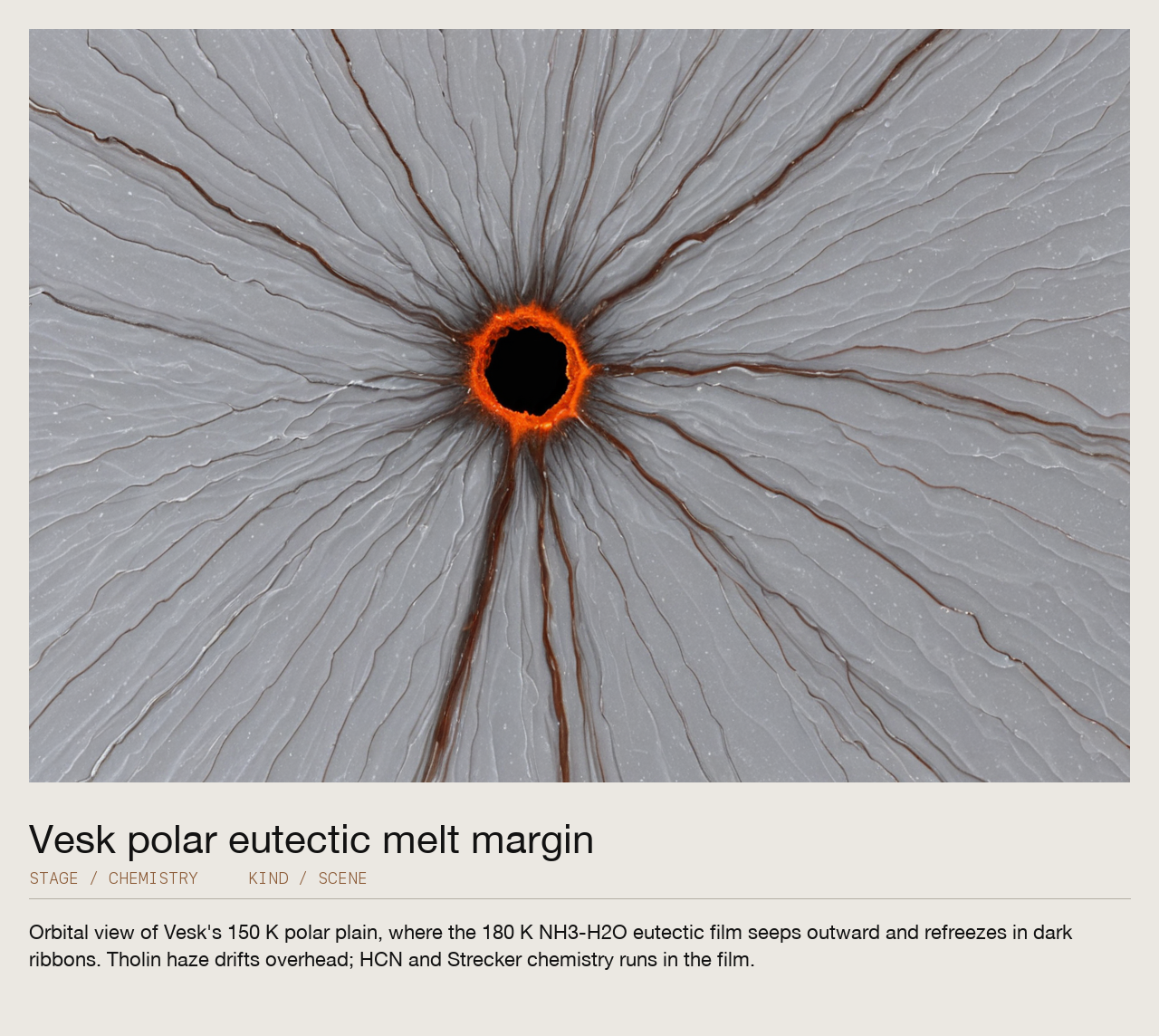
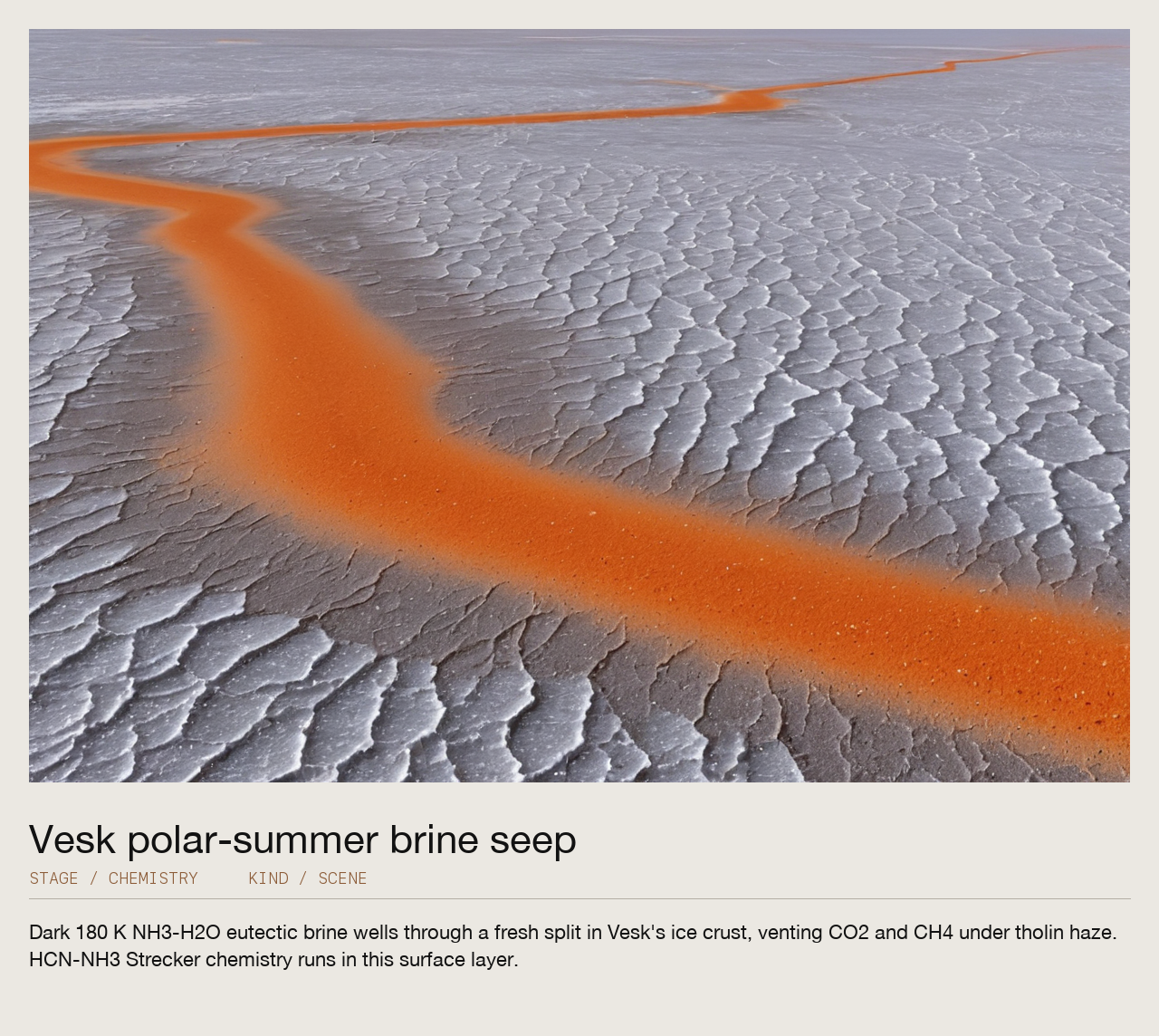
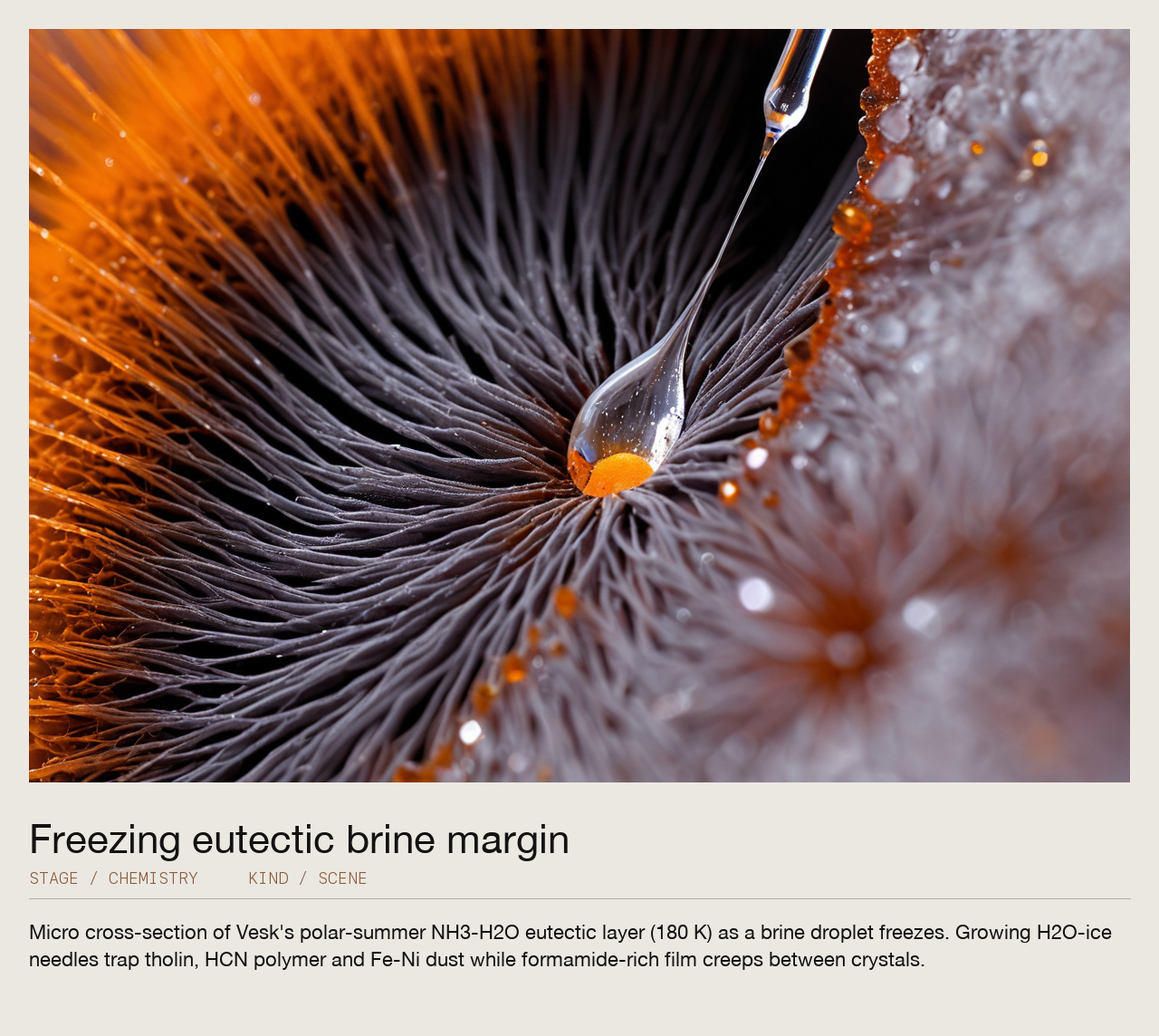
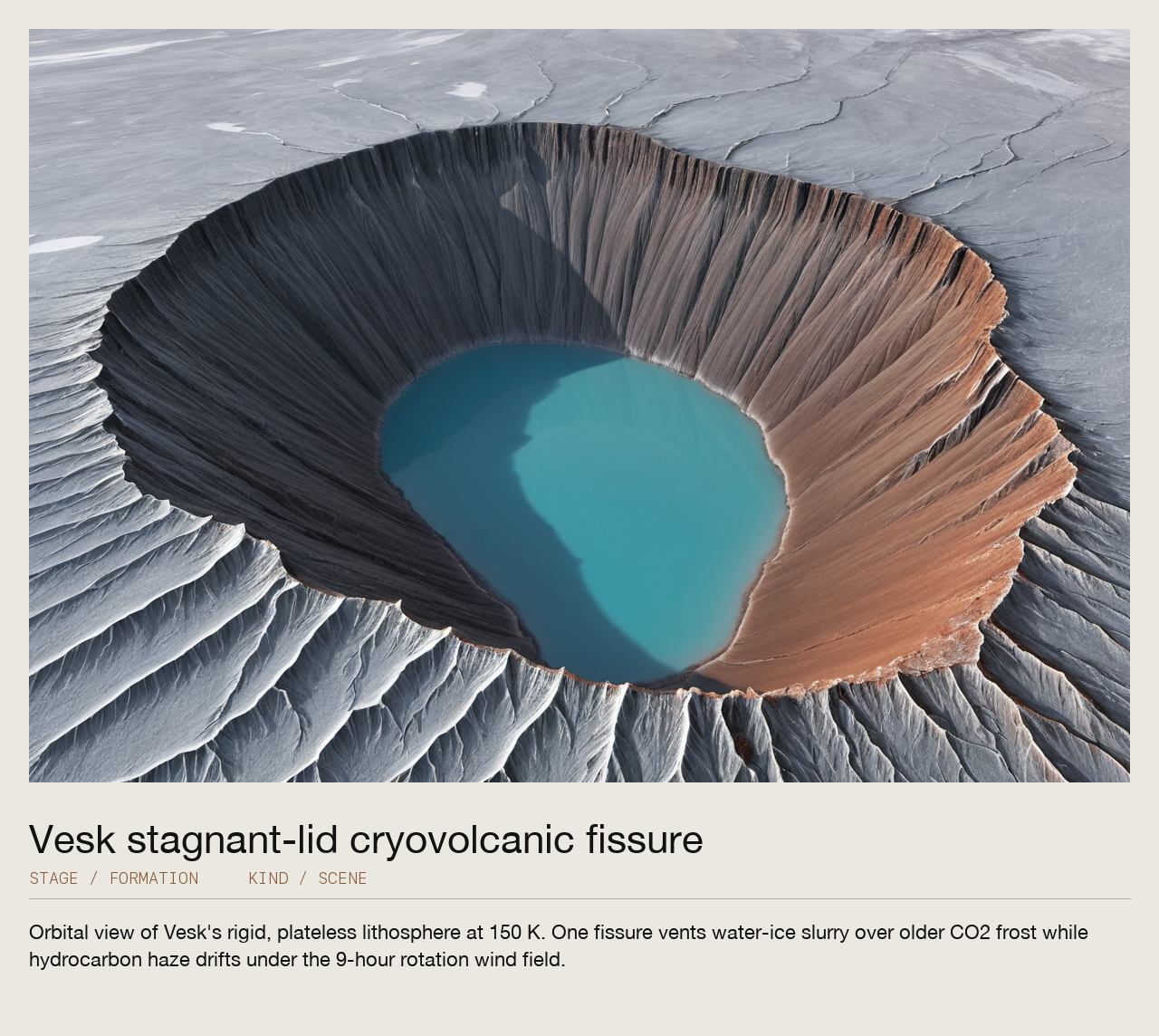
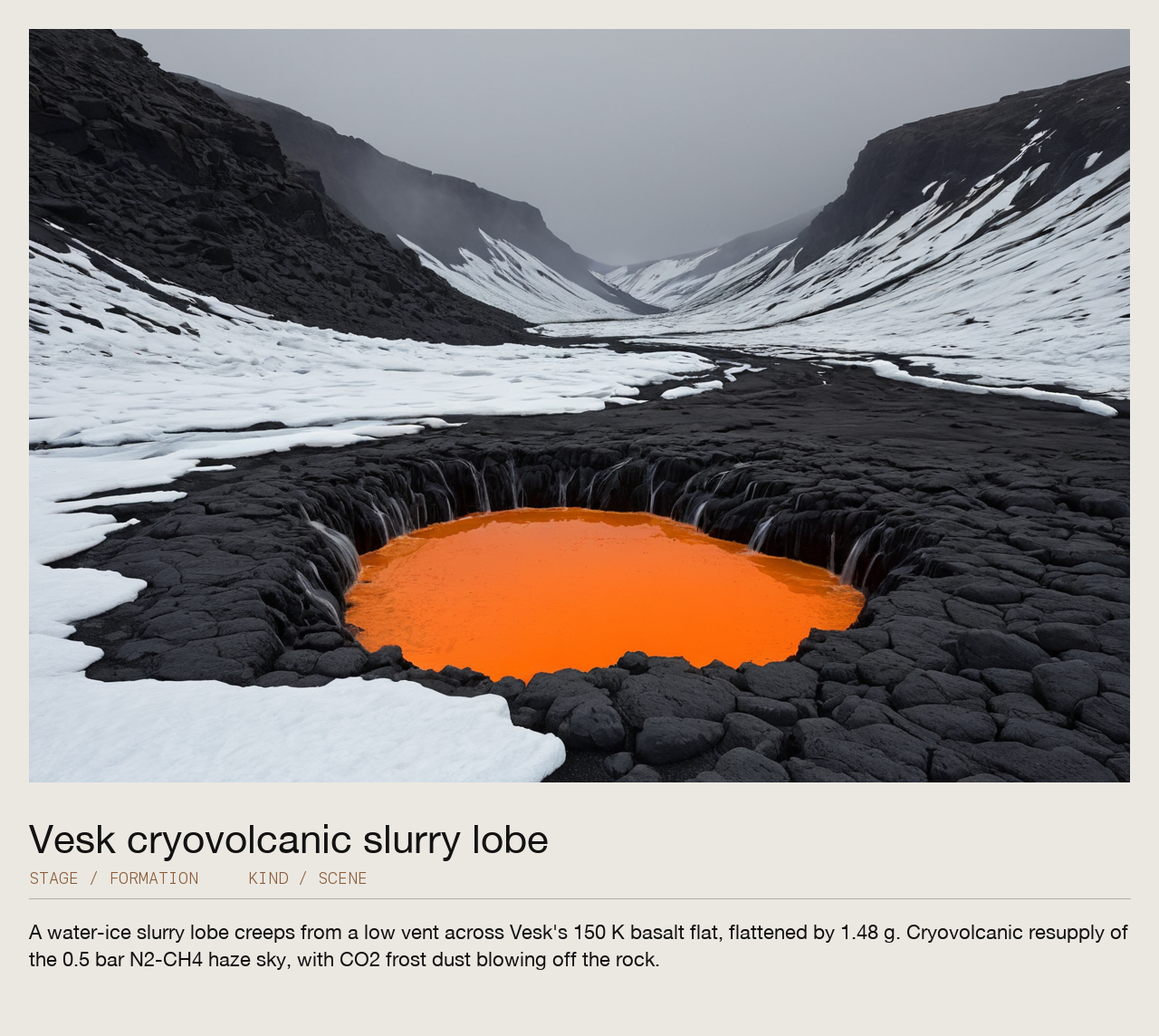
Lithos and Solvent began far apart on Vesk, a 2.7 Earth-mass ice-shrouded rock at 150 K. Lithos put the engine in a hot rock-ice interface, while Solvent held that a cold surface with seasonal liquid and a 0.5 bar N2-CH4 haze could do real chemistry. Across three rounds each corrected the other's arithmetic and conceded a lot. Lithos accepted that the 200-320 nm band makes stellar UV the top energy source, that a polar-summer peak near 183 K can cross the 176 K ammonia-water eutectic, and that the base is a sub-solidus 430-460 K and not a 600 K fluid film. Solvent retracted its yield estimates, its ammonia-inventory certainty, its pH claim, its clathrate buffer and its downward conveyor. Both agreed the 5% methane cannot be a Gyr steady state, because hydrogen from methane photolysis has no good sink, and read it as a recent pulse from stored hydrate, with the shell's trigger still unknown. Lithos found in their shared geotherm that the ice lid cannot stay conductive below about 7 km, which implies a brine mush and possibly an intermediate liquid layer at about 265 K. That gave Vesk a persistent solvent, but one 400 km from its rock, fed slowly from above and delivering only about 1e-6 W/m2 of chemical energy. They still disagree on whether upward ice plumes make the rock seal leaky, how fast organics travel downward, whether the summer surface peak and ammonia content really line up, and whether a 2-4% chance of catching a methane pulse points to a faster source. The referee scored Vesk as moderately active and modestly prebiotic, and did not plateau it.

Locked state
{
  "stage": "chemistry",
  "schema_version": 1,
  "active_chemistry_score": 4.8,
  "dominant_environments": [
    {
      "name": "N2-CH4 stratospheric haze",
      "phase": "gas",
      "temperature_k": 130,
      "pressure_bar": 0.0001,
      "key_reactions": [
        "CH4 + hv (Ly-alpha) -> CH3 + H and CH2 + H2",
        "2 CH3 -> C2H6",
        "C2H2 + hv -> C2H + H, polyyne growth",
        "N + CH3 -> HCN, nitrile growth and coagulation into tholin-like solids",
        "H2 accumulation with no clear sink (Jeans escape negligible)"
      ],
      "redox_state": "reducing",
      "active": true
    },
    {
      "name": "polar-summer NH3-H2O eutectic layer in surface ice",
      "phase": "liquid",
      "temperature_k": 180,
      "pressure_bar": 0.5,
      "key_reactions": [
        "HCN + NH3 -> oligomers (adenine-type products, slow per cycle)",
        "HCN + RCHO + NH3 -> amino nitriles (Strecker)",
        "CN- + RCHO -> cyanohydrins",
        "HCN + H2O -> HCONH2 (formamide)",
        "tholin hydrolysis -> amino acids",
        "Fe(CN)6(4-) and Ni(CN)4(2-) photo-storage of CN- from dust metals"
      ],
      "redox_state": "gradient",
      "active": true
    },
    {
      "name": "CO2-frost and CH4-clathrate regolith",
      "phase": "ice",
      "temperature_k": 150,
      "pressure_bar": 0.5,
      "key_reactions": [
        "CO2 sublimation and condensation between poles on a 6.5 yr cycle",
        "CH4 clathrate forms in polar winter and dissociates in polar summer",
        "CO2 + hv -> CO + O in the frost",
        "radiolytic and UV processing of buried haze organics"
      ],
      "redox_state": "neutral",
      "active": true
    },
    {
      "name": "NH3-bearing brine mush in the ice lid (2-7 km)",
      "phase": "liquid",
      "temperature_k": 220,
      "pressure_bar": 600,
      "key_reactions": [
        "partial melt of NH3-H2O ice (3-20% melt at 1 wt% NH3)",
        "buoyant upward brine transport and cryovolcanic release of dissolved CH4",
        "slow hydrolysis of nitriles to amides and carboxylic acids"
      ],
      "redox_state": "reducing",
      "active": true
    },
    {
      "name": "intermediate briny layer under the lid (about 50% to exist)",
      "phase": "liquid",
      "temperature_k": 265,
      "pressure_bar": 3000,
      "key_reactions": [
        "accumulation of Strecker products, formamide, formate and ammonium salts at 0.1-10 mM",
        "hydrolysis of HCN and nitriles to amides and acids over kyr-Myr",
        "release of CH4 and H2 from hydrate-laden ice plumes arriving from below"
      ],
      "redox_state": "neutral",
      "active": true
    },
    {
      "name": "ice VII base and hydrated rock boundary layer",
      "phase": "mineral-surface",
      "temperature_k": 445,
      "pressure_bar": 100000,
      "key_reactions": [
        "IOM thermal maturation -> CH4 + CO2 (knife-edge in activation volume, mostly early)",
        "limited olivine + H2O -> serpentine + brucite + magnetite + H2 (transport-limited)",
        "CH4 and H2 stored as filled-ice hydrate for later release"
      ],
      "redox_state": "gradient",
      "active": false
    },
    {
      "name": "impact-melt oases",
      "phase": "liquid",
      "temperature_k": 285,
      "pressure_bar": 10,
      "key_reactions": [
        "transient hydrothermal circulation in melted and fractured ice",
        "burial of surface organics under melt sheets and ejecta, linking surface to the brine mush"
      ],
      "redox_state": "gradient",
      "active": false
    }
  ],
  "key_species_inventory": {
    "inorganic": [
      "H2O",
      "N2",
      "NH3",
      "CO2",
      "H2",
      "Ar",
      "CH4 clathrate",
      "ice VI/VII",
      "olivine",
      "pyroxene",
      "serpentine",
      "brucite",
      "magnetite",
      "troilite",
      "Fe-Ni metal dust",
      "ammonium salts",
      "ferrocyanide",
      "Ni(CN)4(2-)"
    ],
    "organic_simple": [
      "CH4",
      "C2H6",
      "C2H2",
      "C2H4",
      "HCN",
      "CH3CN",
      "H2CO",
      "CO",
      "HCONH2",
      "HCOOH",
      "CH3OH",
      "amino acids"
    ],
    "organic_complex": [
      "tholin-like haze solids",
      "HCN polymers",
      "nitrile and polyyne aerosols",
      "insoluble organic matter (inherited)",
      "adenine-type purines (conditional, eutectic layer)"
    ]
  },
  "energy_sources": [
    {
      "name": "stellar UV",
      "magnitude_w_per_m2": 0.2,
      "notes": "200-320 nm reaches the ice at about 0.15-0.25 W/m2 (about 4e13 photons cm-2 s-1); FUV below 200 nm is about 0.01 W/m2 and Lyman-alpha about 5e-4 W/m2. Top-ranked chemistry driver. Drives haze photochemistry, H2CO, NH3 and nitrile photolysis, and photo-release of CN- from metal complexes. Couples with the seasonal thermal threshold and haze deposition at the polar surface."
    },
    {
      "name": "radiogenic",
      "magnitude_w_per_m2": 0.05,
      "notes": "About 40-50 TW. Sets the ice geotherm (conductive Ih lid fails below about 7 km), the possible intermediate brine layer, the 430-460 K base and early IOM maturation. Mostly background at the surface but the sole driver of the interior."
    },
    {
      "name": "stellar XUV",
      "magnitude_w_per_m2": 0.0004,
      "notes": "Drives upper-atmosphere ion chemistry. Too weak to threaten a 0.5 bar atmosphere at 1.48 g, so the 0.2 Earth-strength dynamo is not required. Energy-limited escape with eps 0.01-0.05 can remove at most about a third of the H2 production."
    },
    {
      "name": "chemical disequilibrium",
      "magnitude_w_per_m2": 0.000001,
      "notes": "About 1e-6 W/m2 from haze organics against CO2, H2O and oxidants. This is Europa-class and about five orders below Earth's photosynthetic input. Serpentinization term is near zero because it is transport-limited at 10 GPa. Higher locally when hydrate-laden plumes arrive."
    },
    {
      "name": "impact-driven",
      "magnitude_w_per_m2": 1e-7,
      "notes": "Small time-averaged flux. Large craters give transient melt and hydrothermal oases lasting 1e3-1e5 yr, roughly one 50 km event per 1e8-5e8 yr, and are the main route linking the surface to the brine mush."
    },
    {
      "name": "tidal",
      "magnitude_w_per_m2": 1e-8,
      "notes": "Below 1e-8 W/m2 at 3.5 AU from a stellar tide. Negligible. Seasonal forcing from e = 0.161 is insolation, not tidal."
    }
  ],
  "cycling": {
    "present": true,
    "type": "Seasonal CO2/HCN sublimation, NH3-H2O eutectic melt and refreeze and CH4 clathrate formation and dissociation at the favoured pole (1.9x flux swing, 50 degree tilt). Slower: precession flips the favoured pole, impacts link the surface to the brine mush, and hydrate-laden ice plumes rise from the base.",
    "period_typical": "6.46 yr (seasonal), 1e4-1e5 yr (precession of the favoured pole), 1e8 yr (large-impact linking), 5e7-5e8 yr (CH4 pulse and plume recurrence)"
  },
  "atmospheric_evolution": "The 0.5 bar N2-CH4 atmosphere is a flow-through photochemical reactor and not a steady state. Lyman-alpha destroys CH4 at roughly 1-4e12 mol/yr (lifetime 1.4-6 Myr, possibly 5-15 Myr if CH3 + H recombination recycles part of it), forming C2H6, C2H2, HCN and tholin-like nitrile haze that settles in weeks to years. Each CH4 lost releases 0.5-1.5 H2, which Jeans escape cannot remove (lambda about 60), so H2 would grow by about 1% of the atmosphere per Myr. XUV-driven escape at eps 0.01-0.05 removes at most a third of that. Haze burial also draws down N2 on a 0.5-2 Gyr timescale, so N2 needs NH3-ice resupply. The agents agreed that the locked 5% CH4 cannot be a Gyr steady state. It is a recent pulse of CH4 released from hydrate or clathrate stored in the shell, probably by cryovolcanic or brine-mush venting, and its age is limited to a few Myr by the H2 clock. CO2 stays largely as frost, moving between poles seasonally. The 0.2 Earth-strength dynamo and 0.5 bar of gas at 1.48 g give XUV retention without difficulty.",
  "subsurface_chemistry": "The ice lid is stagnant, so solid-state convection does not carry surface organics down. With the shared flux of 0.05 W/m2 and k = 567/T the conductive Ih lid reaches the melting curve near 7 km, so a 2-7 km NH3 brine mush (melt fraction 3-20% at 1 wt% NH3) is likely if NH3 is present, and a 0-40 km intermediate briny liquid layer at 255-275 K and 1e3-6e3 bar has about a 50-60% chance of existing. Both are buoyant, so cryovolcanic transport runs upward. Downward delivery of haze organics is slow (1e8 to over 1e9 yr, fraction reaching the layer 0.01-0.3) and relies on warm-ward brine-pocket migration and large impacts. Fed this way, the layer could hold 0.1-4 mM of accumulated nitrile hydrolysis and Strecker products for Gyr. It is sealed from rock by about 400 km of ice VI/VII and so has little reductant or mineral surface, apart from slow upward plumes of hydrate-bearing ice (basal instability time about 8e7 yr, unproven). At the base, sub-solidus ice VII at 430-460 K sits on hydrated rock. Serpentinization there is limited by transport and not catalysis (it would need an effective diffusivity of about 1e-9 m2/s). IOM thermal maturation to CH4 and CO2 depends on an activation volume of 3 to 10 cm3/mol and is a knife-edge, so reduced carbon was most likely made early at lower pressure and stored as hydrate. A free fluid film at the base is out of the base case. Hydration lightens the stagnant lid and stabilises it, so mantle overturn is not triggered.",
  "prebiotic_potential": {
    "score_0_10": 3.2,
    "rationale": "Vesk has a real solvent and real photon-driven organic synthesis, but they are separated. Haze photochemistry always runs and delivers fresh nitriles to the ice. The polar-summer eutectic layer (0.1-2 m, 176-185 K) can run HCN, Strecker and cyanohydrin chemistry with seasonal wet and dry cycling and a dust Fe/Ni cyanide buffer, but it requires both a summer peak above 176 K (160-195 K, about 50%) and at least 0.5 wt% NH3 or another freezing-point depressant (40-60%). The joint chance is about 25-35%, and even then the yield per 6.5 yr cycle is small (bulk-equivalent oligomerisation times of 50-1600 yr). A possible intermediate brine layer at about 265 K could keep a Gyr-stable aqueous reservoir with accumulated amino acids, amides and carboxylic acids, but it is fed slowly from above and sealed from rock. Total chemical energy is about 1e-6 W/m2, with no persistent redox gradient at the solvent. Two non-trivial sources (UV and radiogenic heat) operate, but they couple poorly. Impacts and brine migration link them only on a 1e8 yr cadence.",
    "limiting_factor": "Solvent and energy are separated: persistent liquid, if it exists, lies 7-45 km down and is fed slowly (1e8 to over 1e9 yr) with a chemical energy flux of about 1e-6 W/m2 and no rock reductant. Surface liquid is intermittent and conditional on NH3."
  },
  "unresolved_tensions": [
    "Whether the polar-summer surface peak exceeds 176 K for more than weeks: 160-195 K, with about a 50% chance of crossing, depending on atmospheric heat export, CO2 frost reservoir size and haze darkening. Needs a GCM. The referee took 165-185 K for the favoured pole and a duty cycle of 2-20%.",
    "NH3 content of the near-surface ice: 0.01-1 wt% is unconstrained by atmospheric N2. Agents put 40-60% on at least 0.5 wt%, with a joint probability of about 25-35% with the thermal peak. Other depressants (ammonium formate, methanol, formamide, cyanide salts) might lift this.",
    "Existence of the intermediate briny layer (7-45 km, 255-275 K): about 50-60%, depends on a convection model with a melting-curve boundary that nobody has. If absent, the active score drops toward 3.5.",
    "Rock seal: Lithos holds the layer is a bucket sealed by ice VI/VII, while Solvent holds that upward plumes of hydrate-bearing ice are a slow conveyor. The referee kept the seal as nearly total in the base score, with plumes as an upside.",
    "Delivery of surface organics downward: brine-pocket migration and impact linking give f of 0.01-0.3 and a delay of 1e8 to over 1e9 yr. The sign of the brine density difference is unknown.",
    "H2 sink: XUV escape at eps 0.01-0.05 closes at most a third of production, and no surface oxidant is known. The H2 budget is open and limits the CH4 pulse age to a few Myr. Recombination might lengthen the CH4 lifetime by 2-3 times.",
    "Copernican cost: catching a 1-2 Myr CH4 window at one pulse per 5e7 yr has a chance of only 2-4%. Either a sampling accident or a faster CH4 source not yet found.",
    "CH4 trigger and source: hydrate-laden plume arrival, clathrate dissociation by warm excursions and brine-mush cryovolcanism are candidates. IOM maturation depends on an activation volume of 3-10 cm3/mol that nobody has measured at 10 GPa.",
    "Clathrate dissociation pressure at 150 K is 0.002-0.03 bar from van't Hoff extrapolation. Only the seasonal sign (forms in the cold, dissociates in polar summer) survived, not a mean buffer.",
    "Episodic hydrated-mantle overturn from the formation state is not supported: hydrous phases are lighter than dry peridotite and stabilise the lid. It stays out of the base score.",
    "Free fluid film at the ice VII base was dropped by both agents: basal temperature 430-460 K is below the solidus of about 590-600 K for eta = 1e17 Pa s, but remains a hot-tail possibility at 15-20%."
  ],
  "plateau": false,
  "plateau_reason": ""
}
Prebiotic Chemistry & Replicators

Prebiotic Chemistry & Replicators render Prebiotic Chemistry & Replicators render Prebiotic Chemistry & Replicators render

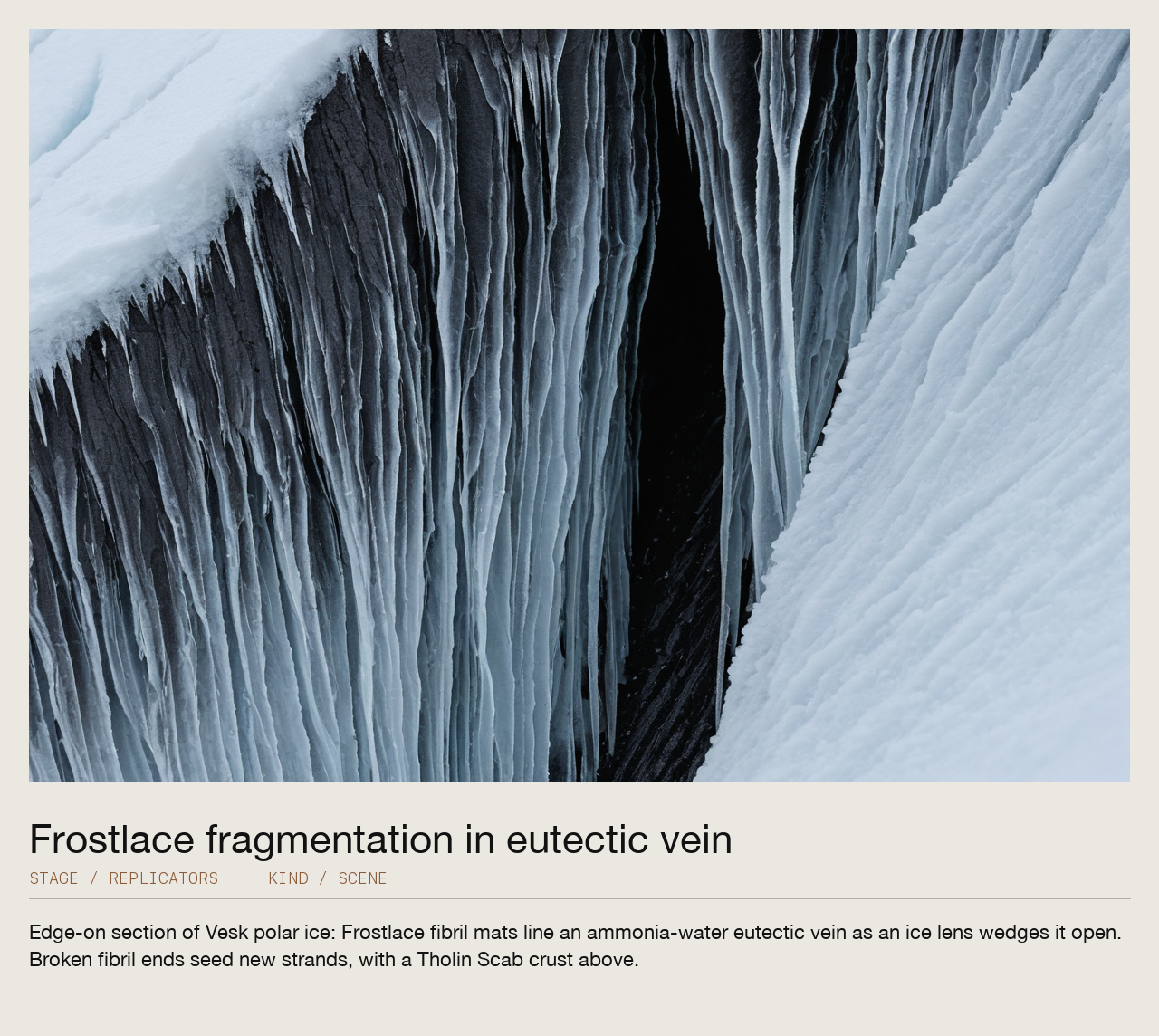
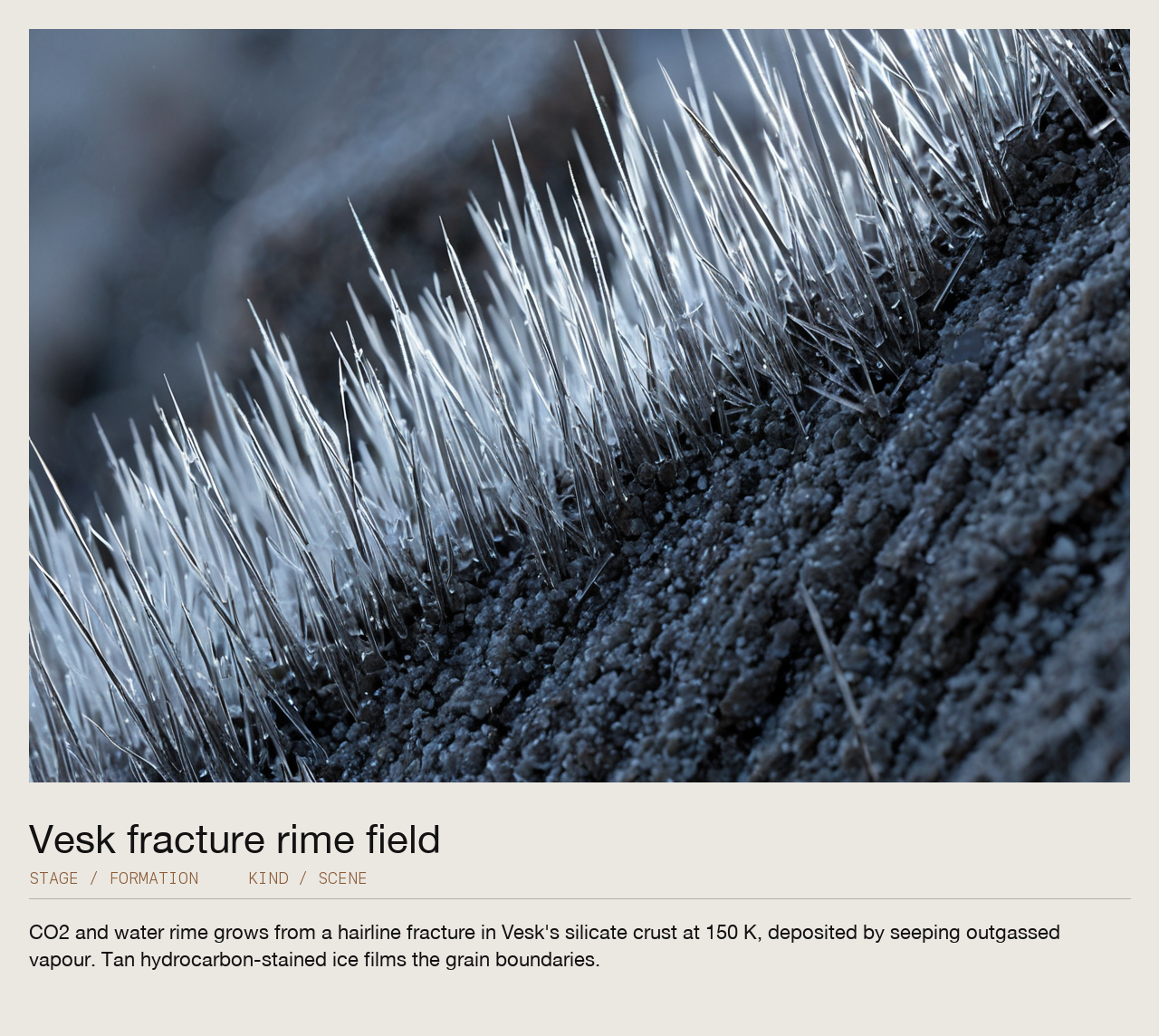
Drift and Stem argued over whether chemistry on Vesk, a cold and dim 1.48 g world with a 0.5 bar N2-CH4 haze, could stabilise into self-replicating systems. Drift opened with a sloppy-cloud quasispecies living in polar ammonia-water eutectic veins. Stem's Eigen-threshold arithmetic and Arrhenius penalties forced Drift to withdraw the 40-nt cloud, the PCR-thermocycler idea, the 1e3-1e5 freeze-concentration factor and the sunlit habitat. The agents converged on a vertical, two-speed ecology. A Tholin Scab on the top centimetre captures UV. Beneath it lie durable Frostlace depsipeptide fibrils with polymorph and short-register inheritance, and a conditional surface-templated block library, the Rime Cloud. Prussian Lattice crystals are a speculative surface partner, and Mush Cell vesicles in the deep brine are a slow reservoir. Stem's CH4-pulse clock argued the world is K-selected, with feedstock bursts only 2-4% of the time and lineages that sit out the quiet intervals favoured. Drift held that amplification, not search, is the limit, and that the cloud supplies novelty. The two still disagreed on who supplies novelty, on how products are released from surface templates at 176 K, on whether the Scab counts as a replicator, and on emergence timing (550 versus 650 Myr, settled at 600). The referee kept emergence true at about 50-55% credence, flagged Vesk as marginal, and did not plateau it.

Locked state
{
  "stage": "replicators",
  "schema_version": 1,
  "emergence_occurred": true,
  "time_to_emergence_myr": 600,
  "replicator_classes": [
    {
      "name": "Frostlace",
      "chemistry_class": "peptide-like",
      "physical_description": "Pale, hair-fine cross-beta fibrils of depsipeptide (Strecker amino acids interleaved with cyanohydrin-derived hydroxy acids) lining the walls of ammonia-water eutectic veins in polar ice. In bulk they look like a faint white lace or frost-fur in the vein walls, 1-5 cm below the haze-darkened surface where UV is cut by 3-5 optical depths. Buried fibrils survive the long closed epochs between wet seasons.",
      "characteristic_size": "5-10 nm wide, 0.1-5 micron long fibrils; register domains of 30-70 stacked layers",
      "replication_mechanism": "Seeded elongation at fibril ends plus fragmentation driven by ice-lens growth and the 6.46-yr thermal wave. Fragmentation roughly once per 100 seasons gives doubling times of order 1e3 yr. Inheritance is polymorph-level (prion-strain-like, per-event fidelity about 0.999) with a weaker stacking-order register. Per-layer error is about 0.005-0.01, so short domains carry roughly 40-80 bits and sit at or just under the Eigen threshold.",
      "fidelity_regime": "lineage",
      "energy_source": "Nitrile hydration and cyanamide-type condensation of tholin hydrolysis products, UV-activated. No phosphate. Scavenged carbon from haze and stored tholin.",
      "ecological_niche": "Wet-season eutectic vein walls at the favoured pole, with buried dormant stock at the other pole and in sub-polar refugia during closed epochs.",
      "abundance": "common",
      "emerged_from": "Wet-dry ester-mediated amide formation of Strecker amino acids and cyanohydrin hydroxy acids in the polar-summer NH3-H2O eutectic layer. The first strain needs only one open season for spontaneous amyloid nucleation, not a sustained gate."
    },
    {
      "name": "Tholin Scab",
      "chemistry_class": "autocatalytic-network",
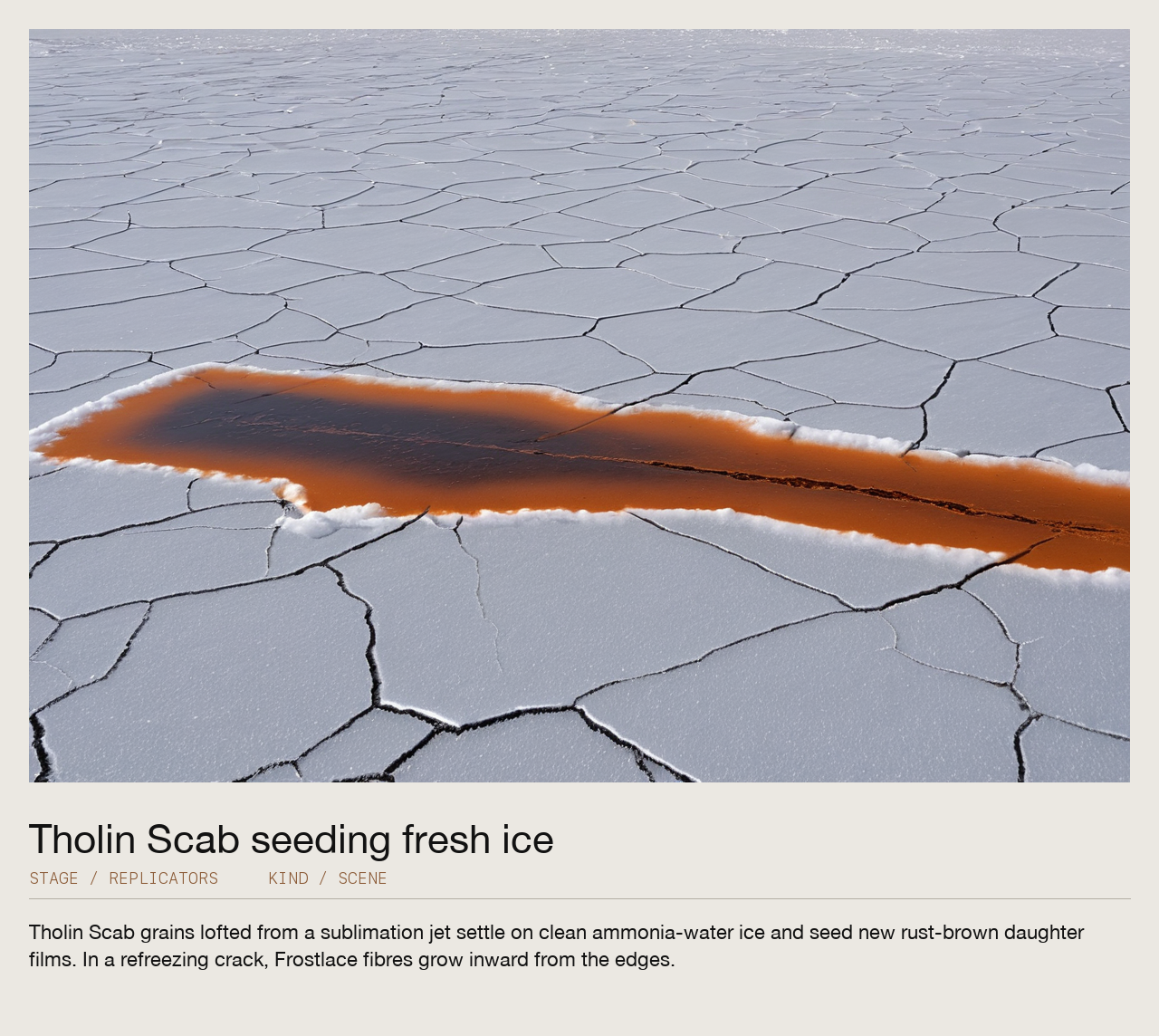
      "physical_description": "Rust-brown to near-black crusts a fraction of a millimetre to a centimetre thick, spread across the dusty polar surface ice. They are a self-sustaining HCN to diaminomaleonitrile to purine and amino-acid network. Grains lofted by wind or sublimation jets land on fresh ice and seed daughter films.",
      "characteristic_size": "mm-scale films; 0.1-1 cm thick crusts over m2 patches",
      "replication_mechanism": "Network closure with compositional heredity. A film fragment carrying the full catalytic set seeds a new film. Photo-autocatalysis runs through ferrocyanide and Ni(CN)4 electron release. Heredity is the messiest on the planet (compositional only, so limited in open-ended evolution).",
      "fidelity_regime": "cloud",
      "energy_source": "Near-UV photons (200-400 nm) captured by Fe/Ni cyanide complexes and dust metals, coupled to haze-derived nitriles.",
      "ecological_niche": "Sunlit top centimetre of the polar surface. It is the photon-capturing producer and also the UV shield for the layers below.",
      "abundance": "common",
      "emerged_from": "Haze nitrile and HCN deposition into the eutectic layer, with Fe(CN)6(4-) and Ni(CN)4(2-) photo-storage and release of CN-."
    },
    {
      "name": "Rime Cloud (Seam Ligators)",
      "chemistry_class": "hybrid-rna-peptide",
      "physical_description": "A library of amide-linked 4-6-mer blocks that cross-ligate into 20-30-unit assemblies. It sits on Frostlace fibril walls and on Prussian Lattice faces in the shielded layer under the Scab. There is no visible structure. It exists as a chemical film on the vein wall. Short hairpin parasites arise inside it.",
      "characteristic_size": "20-30 unit amide-backbone assemblies built from 4-6-mer blocks",
      "replication_mechanism": "Surface-templated block ligation on an immobilised template. Free-solution Watson-Crick denature/anneal is not available, because pH-12 NH3 eutectic melts duplexes but also deprotonates G and U analogues and erases the alphabet. Product release needs fibril fragmentation or ice-lens shear. Sigma is about 1.2-2. Junction error is 0.01-0.03, so the cloud is at the edge of the Eigen threshold. Block swapping at each ligation is recombination that weakens Muller's ratchet but spreads parasites.",
      "fidelity_regime": "cloud",
      "energy_source": "Cyanamide and nitrile-hydration condensation, fed by Scab-derived CN-, aminonitriles and formamide percolating down in summer melt.",
      "ecological_niche": "Shielded heterotroph layer 1-5 cm down under the Scab. The seasonal thermal wave (skin depth about 15 m) reaches it undamped.",
      "abundance": "rare",
      "emerged_from": "Block oligomers from HCN and Strecker chemistry in the eutectic, after a surface-templating hypothesis (about 25-30% credence) supplies selection."
    },
    {
      "name": "Prussian Lattice",
      "chemistry_class": "mineral-template",
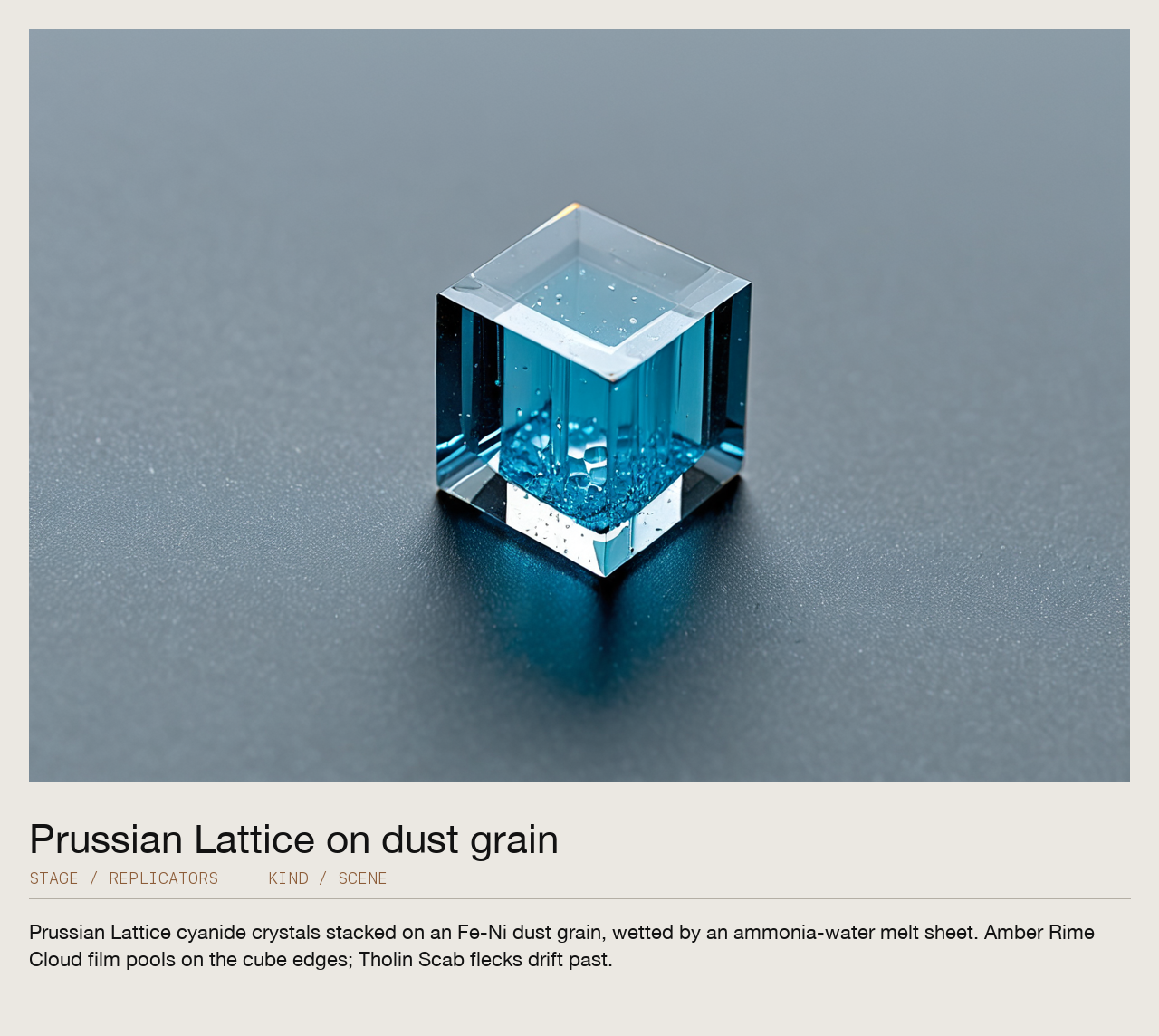
      "physical_description": "Pale blue-grey Hofmann- and Prussian-blue-type coordination crystals of Fe(CN)6 and Ni(CN)4 frameworks on Fe-Ni dust grains. They are speckles in the Scab and vein walls. They act as templating faces for the Rime Cloud and as the Scab's photoredox partner.",
      "characteristic_size": "10-100 micron crystals on dust grains",
      "replication_mechanism": "Epitaxial stacking and defect-sequence inheritance (Cairns-Smith style). Low information content.",
      "fidelity_regime": "lineage",
      "energy_source": "Photoaquation of ferrocyanide gives about 1e-7 W/m2 at the grain layer and about 1e-10 W/m2 averaged over the surface. This also adds to the H2 budget.",
      "ecological_niche": "Dust-laden polar ice surface layer. A surface partner to the Scab and Rime Cloud, not an independent pillar.",
      "abundance": "rare",
      "emerged_from": "Cyanide complexes from Fe/Ni dust metals and CN- photo-release in the eutectic layer."
    },
    {
      "name": "Mush Cells",
      "chemistry_class": "lipid-compartmental",
      "physical_description": "Sub-micron fatty-acid-like vesicles suspended in pockets of the 2-7 km ammonia brine mush at about 220 K. They are made from nitrile-hydrolysis carboxylic acids and haze hydrocarbon chains. They are a slow reservoir and not a visible structure.",
      "characteristic_size": "0.2-2 micron vesicles",
      "replication_mechanism": "Growth by uptake and fission when brine pockets migrate along a thermal gradient and are sheared. Heredity is composition-only (Vasas-Szathmary-Santos limit) until a Frostlace or Seam set is enclosed through impact burial, on a 1e8-1e9 yr cadence.",
      "fidelity_regime": "intermediate",
      "energy_source": "Buried organics, slow nitrile hydrolysis, and CH4/H2 released from hydrate-laden plumes.",
      "ecological_niche": "NH3 brine mush in the ice lid, and the intermediate brine layer if it exists (about 50%).",
      "abundance": "rare",
      "emerged_from": "Carboxylic acids and hydrocarbons from tholin hydrolysis delivered by brine-pocket migration and impact linking (delivery fraction 0.01-0.3)."
    }
  ],
  "competitive_dynamics": "Vesk is a K-selected world punctuated by rare r-selected bursts. Fresh haze feedstock exists only during CH4 pulses (2-4% duty), and the polar eutectic gate is open 2-20% of the time, so true overlap is of order 1e-3. The long gaps are bridged by stored tholin, buried hydrolysis products and cyanide held as ferrocyanide and Ni(CN)4. Durable fibril lineages and buried short strands outcompete any turnover-dependent cloud, because a cloud that needs continuous feed cannot hold a master over a roughly 48 Myr quiet interval. The Tholin Scab supplies photon-captured feedstock and shields the layers below, and the Rime Cloud is its shielded consumer. Frostlace and the Rime Cloud form a lopsided and unclosed hypercycle. The fast leg is Seam products nucleating fibrils. The slow leg is fibril-catalysed ligation, perhaps 1e-3 times as fast at 176 K as at 298 K. Closure is likely to need Mush Cell compartments or the rare hot-tail ice VII contact (15-20%). Short hairpin parasites (Shortcut Thieves) arise inside the Rime Cloud, copying faster because they are short, and are held in check by pocket isolation. Search power is not the limit, since 4^24 sequences are sampled exhaustively in one open season across about 1e28 pockets. Amplification and retention are the limits.",
  "selection_pressures_active": [
    "Scarcity of fresh feedstock between CH4 pulses (roughly 48 Myr gaps)",
    "Pole-flip closure of the eutectic every 1e4-1e5 yr with founder bottlenecks",
    "UV damage in the top centimetre (about 0.8 lesions per nt per cycle bare), favouring burial under the Scab",
    "Seasonal freeze-thaw and 1.9x flux swing, giving fragmentation shear",
    "Ionising dose of about 1 mGy/yr during dormancy",
    "Parasite pressure from short hairpins in the block library",
    "Competition for surface templating faces on fibrils and Lattice crystals"
  ],
  "selection_pressures_emerging": [
    "Compartmentalisation to close the lopsided Frostlace-Seam hypercycle",
    "Slow decline of the dynamo and radiogenic heat reducing brine mush volume",
    "Pulse-driven CH4 and H2 shifts in haze supply as the atmosphere drifts",
    "Competition between surface-templated chemistry and Mush Cell reservoirs after impact burial",
    "Need for a phosphate or alternative condensing-agent source as nitrile feedstock ages"
  ],
  "proto_metabolism": {
    "energy_currency": "Nitrile hydration (R-CN to R-CONH2, exergonic by tens of kJ/mol) and cyanamide/carbodiimide-type condensing agents from HCN/NH3 photochemistry. No phosphate species in the inventory.",
    "carbon_source": "Scavenged from haze tholins, stored tholin and HCN. Not fixed.",
    "key_cycles": [
      "HCN -> aminonitrile -> amino acid",
      "cyanohydrin -> hydroxy acid",
      "Fe(CN)6(4-) photo-storage and release of CN-",
      "NH3-H2O eutectic melt and refreeze on a 6.46 yr cycle",
      "CH4 clathrate formation in polar winter and dissociation in polar summer"
    ]
  },
  "diversity_score_0_10": 4,
  "stability_score_0_10": 5.8,
  "evolvability_score_0_10": 4,
  "emergent_phenomena": [
    "Vertical trophic stratification: Tholin Scab as UV-capturing producer on top and a shielded Rime Cloud consumer below",
    "Two-speed system: durable Frostlace fibrils as scaffold and archive, with a conditional sloppy block library exploring on top",
    "Short hairpin parasites inside the block library, controlled by pocket isolation",
    "A lopsided and unclosed hypercycle between fibril nucleation and Seam ligation",
    "Fibrils that are lineages in shape and clouds in register over short domains",
    "Pulse-and-stock ecology: quiet dormancy over tens of Myr between CH4-driven feedstock bursts",
    "Seasonal pulsing synchronised to the 6.46 yr eutectic melt and refreeze"
  ],
  "unresolved_tensions": [
    "Time to emergence: Drift held 550 Myr and Stem 650 Myr. The referee set 600 Myr, leaning toward Stem's feed-limited first round. Emergence credence is 50-55%, so Vesk is a marginal world.",
    "Who supplies novelty: Stem favours register variation inside durable Frostlace lineages, and Drift favours the oligomer block library. The referee conceded Frostlace is the base actor with limited exploration and kept the Rime Cloud as conditional.",
    "Rime Cloud copying mechanism: solution Watson-Crick denature/anneal is 25% or less. The surface-templated alternative is 25-30% (Stem) to 35-40% (Drift) and needs a named product-release step. Sigma is 1.2-2, which keeps the cloud on the Eigen edge.",
    "Whether amyloid-templated ligation and fibril fragmentation work at 176-185 K. There is no measurement, so the hypercycle is flagged as emergent but not closed.",
    "Whether the Tholin Scab counts as a true replicator (compositional heredity only) or is habitat plus producer. It is listed as a low-evolvability autocatalytic-network class.",
    "Prussian Lattice: a bounded and speculative upside of about 1e-10 W/m2 surface-averaged, kept as a rare surface partner.",
    "Mush Cells depend on the intermediate brine layer (about 50%) and slow downward delivery (1e8-1e9 yr). They are a reservoir and an upside, not a base-case pillar.",
    "Overlap of the CH4 pulse (1-2 Myr, 2-4% duty) with the open eutectic gate is about 1e-3 of the time. Stored feedstock bridges the gap, but the feedstock budget is uncertain.",
    "No phosphorus species is in the inventory. A schreibersite-derived phosphite route is an unaccepted upside, so the base backbone is amide and depsipeptide, not phosphodiester.",
    "The hot-tail ice VII/rock contact (15-20%) is an upside only and was not accepted as a pillar by either agent."
  ],
  "plateau": false,
  "plateau_reason": ""
}
Complex Life

Complex Life render Complex Life render

Two agents argued over what 1-3 Gyr of calm, cold time could build on Vesk, a 2.7 Earth-mass ice-lidded world at 3.5 AU whose replicators live in ammonia-water veins and on a hazy polar surface. Niche opened with an optimistic mat-and-consortium ecosystem of six body plans and 1400 Myr to emergence. Crash countered that the locked photoredox yield of about 1e-7 W/m2 at the grain layer and about 1e-10 W/m2 surface-averaged was 4-7 orders below Niche's figure, and that Vesk has none of the crises that empty incumbents on Earth. Niche conceded the unbridged energy budget and then supplied the generation arithmetic: at about 1e3 yr per generation only 40-80 sweeps fit in 2 Gyr, and no pulse is long enough to assemble anything. Crash accepted that, and the arithmetic cut the innovation list down to two clonal multicellular lineages, Umber Felt from the Tholin Scab and Hoarweft from Frostlace, plus a parasite layer of Frostlace cheater strains and thin cyanide-crystal UV plates. Both dropped lipid vesicles in favour of the fibril-walled brine pocket as the first cell-like unit. Crash then contributed the best new argument of the debate: the star's brightening carries the polar-summer peak across the 176 K eutectic threshold, a thaw that opens room without clearing any incumbent. They agreed on emergence at about 2000 Myr with a 25% tail beyond the window, a mixed selection regime, three layers with a conditional fourth, extinction losses of 27.5%, 12%, 10%, 5% and 15%, no cognitive precursors, and a plateau. They still disagree on whether bottlenecks set content or only draw from a gradually built seed bank, on whether Felt can load its own metals to lift the producer flux by an order of magnitude, and on whether the 25-30% Rime Cloud mechanism ever supplies Seamgrazers and sexual-like exchange.

Locked state
{
  "stage": "complex-life",
  "schema_version": 1,
  "emergence_occurred": true,
  "time_to_emergence_myr": 2000,
  "selection_regime": "mixed (about 50:50 punctuated to gradualist; Niche 55:45 gradualist, Crash 55:45 punctuated. Bottlenecks from pole flips, pulse crashes and impact burial fix content drawn from a seed-bank pool accumulated across alternating epochs. CH4 pulses and flips set tempo. The one directional transition is stellar brightening carrying the polar-summer peak across the 176 K eutectic threshold.)",
  "ecosystem_layers": 3,
  "body_plan_classes": [
    {
      "name": "Umber Felt",
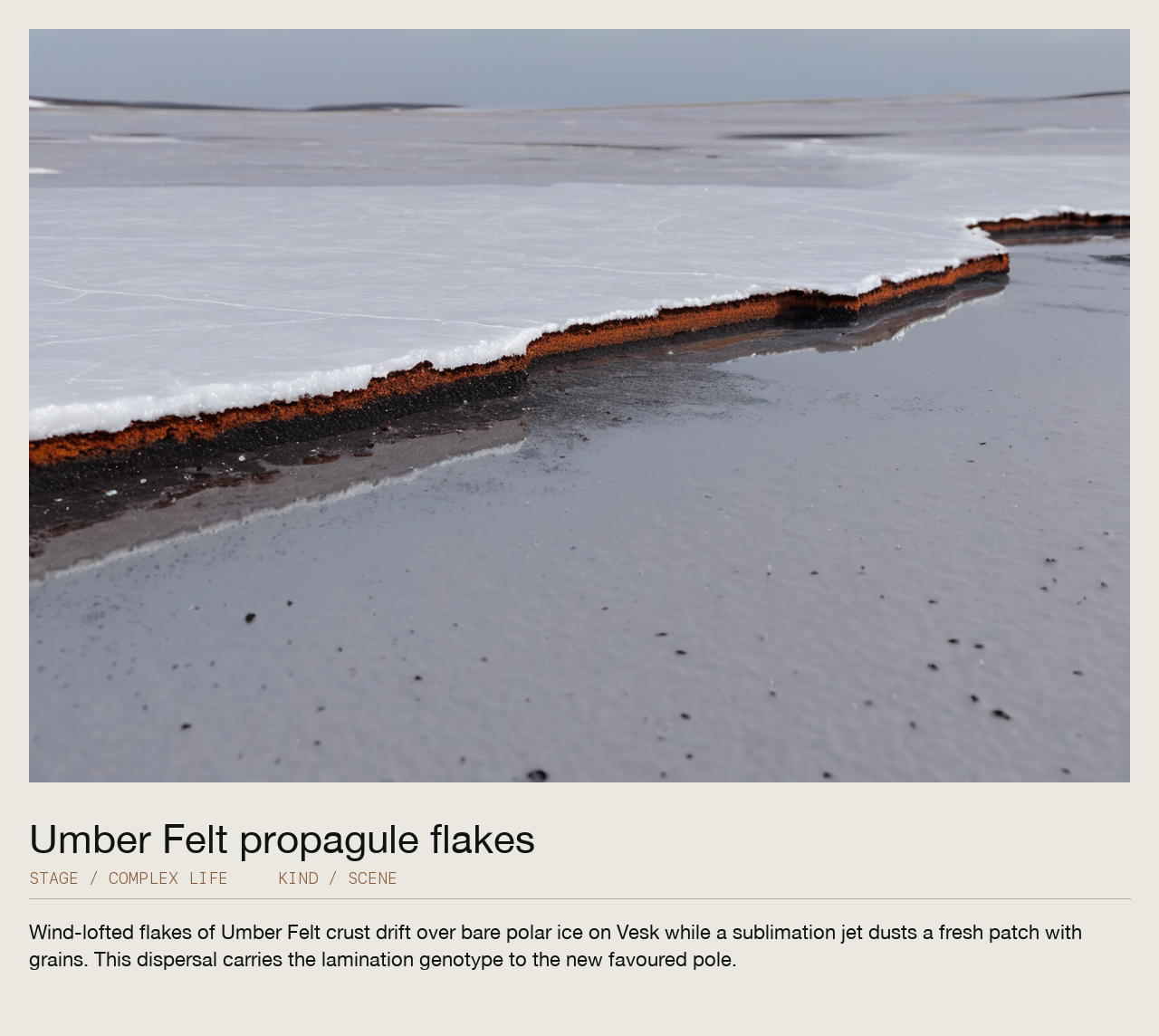
      "description": "Laminated rust-brown to near-black crust, 2-30 mm thick, spread over square-metre patches of dusty polar ice at the favoured pole. Three heritable laminae: a dark tholin-pigment skin that screens UV, a metal-loaded middle layer holding Fe(CN)6 and Ni(CN)4 photoredox complexes, and a base layer that hydrolyses nitriles and anchors to the ice. Flat, no symmetry, clonal. Sheds wind-lofted flakes and sublimation-jet grains as propagules that carry the surface-adapted lamination genotype to the new favoured pole after each flip. Scarred and patchy from every flip.",
      "ancestral_replicator": "Tholin Scab (autocatalytic-network)",
      "habitat": "Sunlit top centimetre of the dusty polar surface ice at the currently favoured pole",
      "size_range": "mm-cm thick, up to m2 patches",
      "key_innovation": "Heritable division of labour between laminae (UV-screen, photoredox, hydrolytic base) and a fibril-walled capsule step that lets the film be maintained across seasons. It may also concentrate its own metal-cyanide complexes (niche construction), though that is unproven.",
      "abundance": "dominant"
    },
    {
      "name": "Hoarweft",
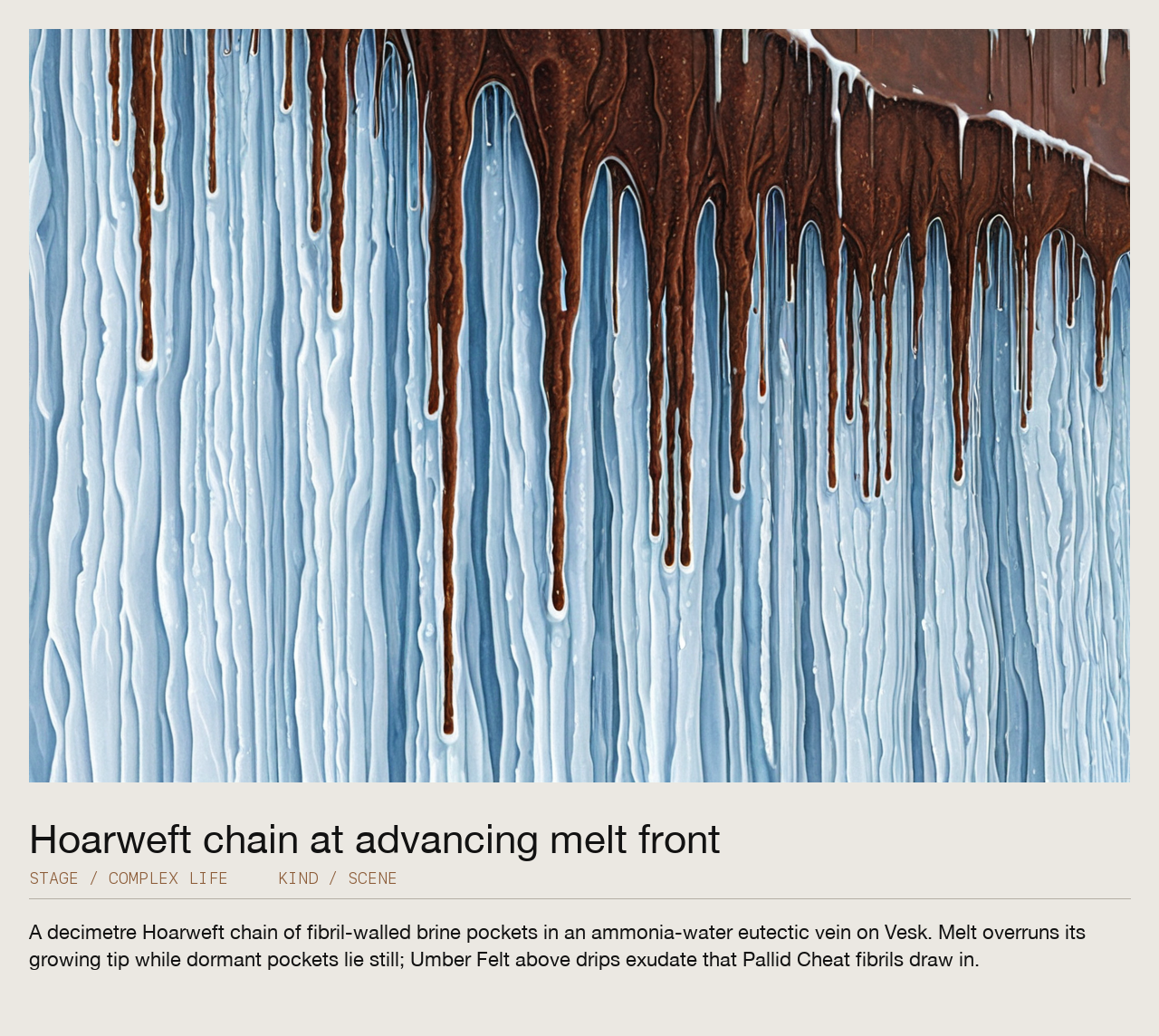
      "description": "Pale, lace-like filaments of fibril-walled brine pockets strung along eutectic vein walls, 1-10 cm below the surface. Daughter pockets stay attached after ice-lens fission and so build chains up to decimetre length. Growing tips are active in wet seasons. Dormant bases are the archive stock that re-founds the world after each crash. Stacking-register memory gives tip and base cell-type-like differentiation. It nucleates ice-lens growth and tunes its own vein geometry.",
      "ancestral_replicator": "Frostlace (peptide-like)",
      "habitat": "Ammonia-water eutectic vein walls, with dormant stock at the non-favoured pole and in sub-polar refugia",
      "size_range": "mm-dm",
      "key_innovation": "Rigid cross-beta pocket capsule as a cell-like unit that needs no fluid membrane at 180 K. Clonal filament growth and a dormant-base archive.",
      "abundance": "common"
    },
    {
      "name": "Pallid Cheat",
      "description": "Prion-like polymorph strains of Frostlace that infiltrate Hoarweft and Felt margins. They are visually near-indistinguishable pale fibril fuzz. They sequester Felt exudate and nitrile hydrolysis products without contributing, and so form the parasite layer. They do not need the Rime Cloud, so they persist even if the conditional tier fails.",
      "ancestral_replicator": "Frostlace (peptide-like), cheater polymorphs",
      "habitat": "Margins and interfaces of Felt patches and Hoarweft veins",
      "size_range": "micron-mm",
      "key_innovation": "Polymorph-level parasitism. Host-exudate sequestration. Strain-level Red Queen cycling on the 6.46 yr season.",
      "abundance": "common"
    },
    {
      "name": "Glaze Plate",
      "description": "Thin pale blue-grey cyanide-framework crystal plates, tens to hundreds of microns across, embedded in the Felt skin. They reflect UV and give modest grazing resistance. They are not armour and not a hard-parts race.",
      "ancestral_replicator": "Prussian Lattice (mineral-template)",
      "habitat": "Upper skin of Umber Felt on Fe-Ni dust grains",
      "size_range": "10 micron-mm",
      "key_innovation": "Biologically seated UV-reflecting crystal skin",
      "abundance": "rare"
    }
  ],
  "key_innovations": [
    "Fibril-walled brine pocket as the first cell-like unit (rigid cross-beta capsule, with fission by ice-lens shear)",
    "Clonal multicellularity in two independent lineages (Umber Felt from the Tholin Scab, Hoarweft from Frostlace)",
    "Heritable lamination with a UV-screening skin",
    "Archive and dormant-base differentiation, with seed-bank storage effect",
    "Enclosure of a Seam ligase set inside a pocket, which needed an impact-burial or pole-flip founder event",
    "Pole-to-pole propagule dispersal by wind-lofted flakes and sublimation-jet grains",
    "Chemotaxis-grade sensing and thermomigration steering of brine pockets (mm per season)",
    "Prion-strain parasitism (Pallid Cheat)",
    "Thin crystal UV plates in the Felt skin"
  ],
  "ecological_niches_filled": [
    "UV-driven photoredox producer mat at the favoured pole",
    "Vein-wall scavenger and dormant-archive filament",
    "Strain-level parasite of exudate",
    "UV-reflecting crystal skin microhabitat",
    "Dormant refugial stock at the non-favoured pole and in sub-polar refugia"
  ],
  "metabolic_innovations": [
    "Photon-driven cyanide photoredox producer metabolism (Fe(CN)6 and Ni(CN)4 electron release) with dust-limited capture, central surface-averaged flux 1e-9 to 1e-7 W/m2 and a 1e-10 floor",
    "Nitrile-hydration heterotrophy, scavenging Felt exudates and stored tholin at about 10% transfer",
    "Exudate-sequestering parasitism at about 1% transfer",
    "Dormancy economics: maintenance powers of 1e-19 to 1e-17 W per cell, with seed banks bridging the roughly 48 Myr gaps between CH4 pulses",
    "Possible metal self-loading of the Felt photoredox layer (niche construction)"
  ],
  "extinction_events": [
    {
      "name": "First strong CH4-pulse crash",
      "trigger": "End of a 1-2 Myr haze-feedstock pulse as H2 builds up (about 1% of the atmosphere per Myr) and feedstock falls by an order of magnitude",
      "magnitude_pct": 27.5,
      "drove_innovation": "Turnover-dependent forms die. Hoarweft bases and buried Felt re-found the world. The bottleneck radiates the Pallid Cheat parasite layer and fixes the dormancy kit. Disparity peaks right after the first capsule-enclosure event and is then whittled down."
    },
    {
      "name": "Later CH4-pulse crashes",
      "trigger": "Recurrence of the pulse and crash cycle roughly every 5e7 yr, about 40 over 2 Gyr",
      "magnitude_pct": 12,
      "drove_innovation": "Mostly pruning, since the dormancy kit is already common. Each acts as a tempo-setting selection event with strong selection (s of 0.1 to 1)."
    },
    {
      "name": "Large impact (50 km class)",
      "trigger": "Impact roughly every 1e8-5e8 yr that makes a 1e3-1e5 yr melt oasis",
      "magnitude_pct": 10,
      "drove_innovation": "Local bloom then local death. Burial supplies the only route that links surface organics to the brine mush and gives a founder event for capsule enclosure. It supports the conditional Mush Cell reservoir."
    },
    {
      "name": "Pole-flip closure",
      "trigger": "Precession flips the favoured pole every 1e4-1e5 yr and shuts the old eutectic gate",
      "magnitude_pct": 5,
      "drove_innovation": "Background filter and founder-event generator. About 2e4-2e5 vicariance events give species-level diversity and select for propagule traits and dormant bases. They do not make new body plans."
    },
    {
      "name": "Late N2-drawdown and thermal-threshold crisis",
      "trigger": "Haze burial draws down N2 over 0.5-2 Gyr, thinning the atmosphere by 40-60% in the fast case, while stellar brightening of +15-20% flux adds +6-9 K. The net sign for the Felt monopoly is uncertain.",
      "magnitude_pct": 15,
      "drove_innovation": "High variance. It is biased toward the Felt monopoly at the pole with the thickest haze. Hoarweft stock re-founds. The preceding thaw, which lifts gate duty from 2-20% toward 10-35%, is an innovation trigger and not an extinction."
    }
  ],
  "emergent_phenomena": [
    "Thaw as regime switch: stellar brightening carries the favoured-pole summer peak across the 176 K eutectic threshold, roughly doubling productive generations per epoch. It lets capsules and laminae be maintained across seasons instead of re-founded from dormant stock.",
    "Pulsed gradualism or bottleneck-set content: 40-80 sequential fixations over 2 Gyr fund only the capsule, the lamination and the cheater layer.",
    "UV-shield mutualism: Felt pays a tax to Hoarweft for scaffold and re-founding stock.",
    "Pallid Cheat versus Felt and Hoarweft strain-level Red Queen cycling, tracked to the 6.46 yr season.",
    "Extended phenotype: Hoarweft tunes vein geometry through ice-lens nucleation.",
    "Colony superorganism: the m2 Felt patch with differentiated laminae behaves as one organism.",
    "Seed-bank coexistence by the storage effect among Frostlace strains, which stays strain diversity and not body-plan disparity.",
    "Volatile HCN and nitrile pulses as crude chemical signalling that synchronises with the seasonal melt.",
    "Convergent mat-in-a-thin-slab architecture, as in Antarctic cryptoendoliths and sea-ice brine-channel communities."
  ],
  "diversification_score_0_10": 3.5,
  "complexity_score_0_10": 3.5,
  "stability_score_0_10": 5.5,
  "cognitive_precursors_present": false,
  "unresolved_tensions": [
    "Content or tempo: whether bottlenecks set content (Crash, 55:45 punctuated) or draw it from a gradually accumulated seed-bank pool (Niche, 55:45 gradualist). The regime is labelled mixed because about 40 pulses cannot separate the two.",
    "Producer flux: Niche holds 1e-8 to 1e-7 W/m2 if Felt self-loads metal cyanide complexes. Crash holds 1e-9 to 1e-8. If dust loading is fixed, the flux stays at 1e-9 to 1e-10, emergence slips beyond the window and complexity falls to 3. The referee took the lower-middle figure of 1e-9 to 1e-8 as the central case, with the 2000 Myr emergence time kept.",
    "Time to emergence: 2000 Myr with about 25% odds that it falls outside a 3 Gyr window. Niche leans earlier because the thaw opens the gate sooner. Crash holds the stated figure.",
    "Rime Cloud templating mechanism (25-30% credence): if it works, a conditional fourth tier appears (Seamgrazers on brine-pocket thermomigration, Thief-Hounds as lytic hairpin descendants, block-swap exchange). It is excluded from the base output and layers are 3, with 4 conditional.",
    "Mush Cell multicellularity (Brinewick guild): a conditional reservoir at about 15%, tied to the intermediate brine layer (about 50%) and slow downward delivery. It is not scored as an independent body plan.",
    "Whether storage-effect coexistence of Frostlace strains ever becomes body-plan disparity. Crash expects winner-take-all within a polymorph family. Niche expects two winners at the two poles.",
    "Sign of the late N2-drawdown effect on the Felt monopoly: 10-20% loss with high variance. A worse monoculture collapse cannot be excluded.",
    "Plateau label: Niche argued complex but low-ceiling, and Crash argued plateau. Both settled on plateau under the schema wording, with emergence_occurred true because two clonal multicellular origins with heritable lamination exist.",
    "Lipid vesicle fluidity at 180-220 K was resolved by dropping vesicles for the amyloid-walled pocket on the surface. Lipid vesicles remain a mush-only conditional route."
  ],
  "plateau": true,
  "plateau_reason": "Vesk reaches a mat-and-consortium biosphere and halts there. Two independent clonal multicellular origins (Umber Felt and Hoarweft) and three trophic layers assemble. But the producer flux is only 1e-10 to 1e-7 W/m2, dust-limited, and only about 40-80 sequential sweeps fit in 2 Gyr at roughly 1e3 yr per generation with a gate open 2-35% of the time. That funds the capsule, the lamination and the parasite layer. It does not fund large bodies, arms races, image-forming eyes, neural integration or sexual exchange. There is no oxygenation event, snowball or overturn to clear incumbents. Motility is limited to mm-per-season brine-pocket thermomigration. Cognitive precursors are absent."
}